
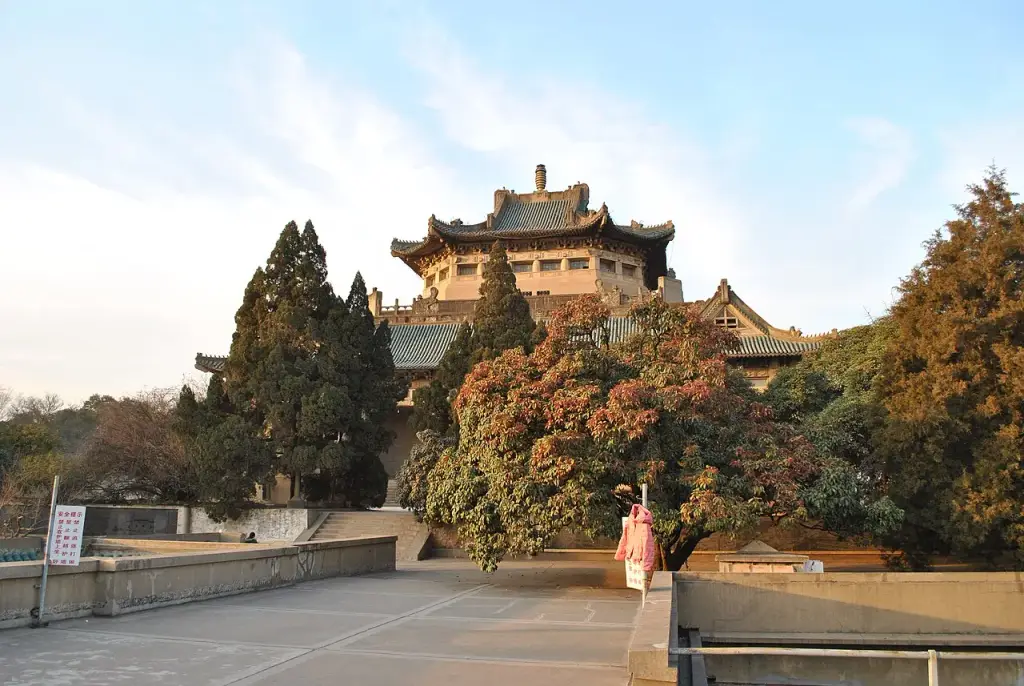
China · Wuhan, Hubei
Wuhan University
Large comprehensive university under the Ministry of Education, with a lakeside and hillside campus
Photo: Howchou · CC BY-SA 3.0
- QS World Ranking 2027
- #165
- Founded
- 1893
- Students
- 56,000
- Bachelor's degree
- 4 years
- Acceptance rate
- Not published; admission by document review, interview and an entrance exam
- How admission works
- Chinese-taught programmes ask for new HSK 4 with 180 or more; English-taught ones ask for TOEFL 80+, TOEFL Essential 8+ or IELTS 6.0+ (exemptions need the university's approval). Applicants submit a CSCA transcript, high school diploma and transcripts, and a financial certificate of US$5,000 or above. Applicants who pass the document review proceed to an interview and entrance exam.
- Language of instruction
- Mostly Chinese (new HSK 4, 180 or more); a few programmes in English (TOEFL 80+ or IELTS 6.0+)
The university publishes no IB or A-level requirement. These are the conditions of the 2026-entry guide; no autumn 2027 guide had been published on 2 November 2026.
Worth knowing
Wuhan University traces its origins to the Ziqiang Institute, founded in 1893 by Zhang Zhidong, then governor of Hubei and Hunan. The university's own page says 26 of its early buildings are listed as national key cultural relic sites. In 2000 it merged with Wuhan University of Hydraulic and Electric Engineering, Wuhan Technical University of Surveying and Mapping and Hubei Medical University.
How hard is it to get in, and why
The university publishes no admission rate. Applicants pass a document review and then an interview and an entrance exam; applicants it recognises as outstanding can be exempted from the interview. Most programmes are taught in Chinese and need HSK 4 with 180 or more, the lowest language bar of the three Chinese universities in this batch. By mechanism it is closest to Melbourne and Toronto: a language bar and document review, then interview and exam, with no published rate.
What it costs
Tuition
$3k–6k per year
The university's fee page gives undergraduate tuition per year: RMB 20,000 (liberal arts), 24,000 (science and engineering) and 30,000 (medicine and stomatology) in Chinese-taught programmes, and RMB 23,000, 28,000 and 40,000 in English-medium ones; it is the current fee page and does not name the 2027 intake. Insurance is RMB 1,000 a year, and the application fee is RMB 800. The living figure is the page's own estimate of RMB 1,000 to 2,000 per month, times 12, a calculation. The university's dormitory table lists on-campus rooms at RMB 6,900 to 16,000 a year, with electricity extra.
Living costs
$2k–4k per year
Scholarships and financial aid
The university's scholarship pages list the Chinese Government Scholarship, the International Chinese Language Teachers Scholarship and the China-Link Scholarship programme. The page links guides by programme and states no undergraduate award amounts, so what each covers is in those guides.
How to apply
Applicants register an account in the university's online application system and upload their documents, including CSCA transcripts, then go through document review and an interview and entrance exam. For the 2026 intake (last year's cycle) self-funded autumn applications ran from 1 October 2025 to 30 June 2026; the autumn 2027 dates are not yet published, while spring 2027 applications run from October to December 2026. The application fee is RMB 800. Applicants under 18 submit a guarantee letter from a guardian in China.
Official websiteWhat makes it special
- 133 undergraduate majors and 42 schools across 13 discipline categories, from philosophy and law to engineering and medicine.
- Three Grade-A tertiary affiliated hospitals.
- The School of International Education arranges on-campus accommodation for new students who register within the specified period; rooms range from twin rooms to suites.
- The 2023-2024 undergraduate quality report counts 1,313 degree-seeking international students on campus.
About studying in China
Four-year degrees, taught mainly in Chinese; tuition and English-taught options differ by university and programme. Peking University takes international applicants through its own online system, or through the Chinese Government Scholarship, and its route without a written exam asks for HSK 6 (score 210 or more), or a 6 or above in IB Chinese HL, so the language bar at the top is high. Check each university's own page for tuition and for any English-taught bachelor's programmes. The honest caveat is that for most students the language, not the grades, decides whether China is realistic.
Teaching staff
The dossier on teaching staff for this university is still being written.
The campus in photographs
Photographs come from Wikimedia Commons under free licences; the author and licence are shown on each image.
Reviews
No reviews yet. Visited, applied, or studied here? Be the first.