
Netherlands · Wageningen, Gelderland
Wageningen University & Research
Dutch life-sciences university for food, agriculture, environment and nature, with eight English-taught bachelor's programmes
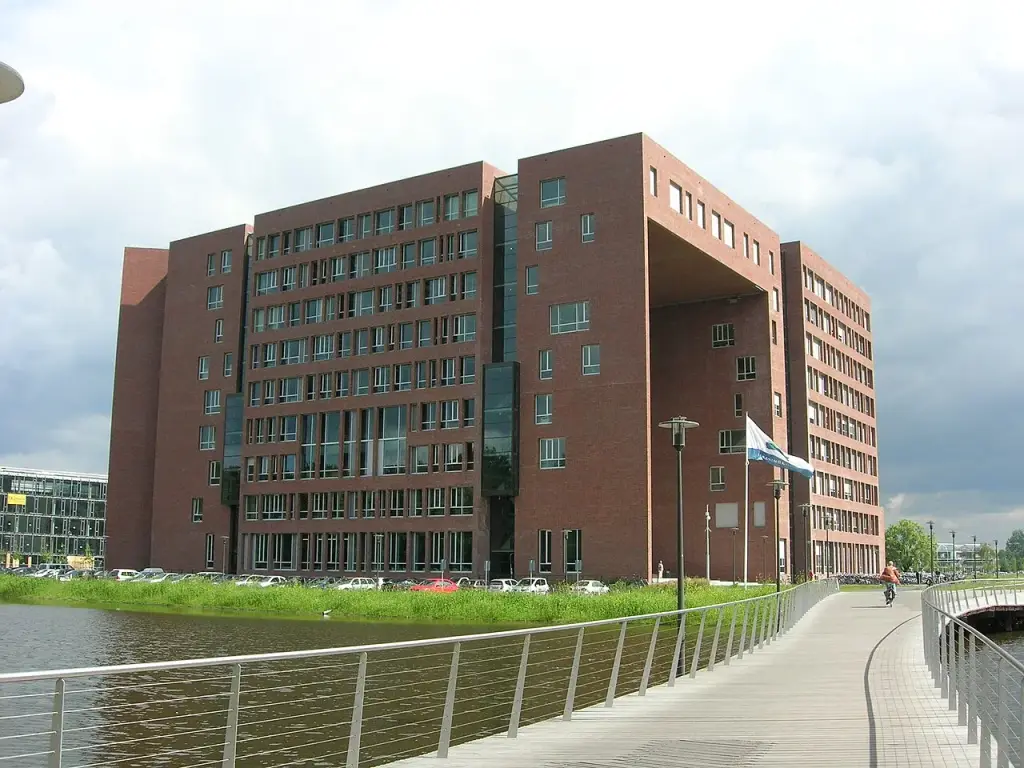
Photo: DirkV · CC BY-SA 3.0
- QS World Ranking 2027
- #154
- Founded
- 1918
- Students
- 14,000
- Bachelor's degree
- 3 years
- Acceptance rate
- Not published; admission depends on the diploma level and subject requirements, with no ranking of applicants
- Typical IB offer
- IB Diploma with Maths (AA SL/HL or AI HL) plus programme sciences, e.g. Chemistry and Biology, one at HL
- Typical A-level offer
- 3 GCSEs and 3 A-levels, all at A*–C, six different subjects in total; programme subjects also required
- How admission works
- Eight bachelor's programmes are taught in English and need Mathematics plus programme-specific sciences (Tourism needs Mathematics only). English is proved by IELTS Academic 6.0 (speaking 6.0) or TOEFL iBT 80 (speaking 20), or 4.5 (speaking 4.0) on the new scale; IB students are exempt with English as the sole language of instruction or English A at grade 5 or higher.
- Language of instruction
- Eight of 21 bachelor's programmes are taught in English: Animal Sciences, Data Science for Global Challenges, Earth System Sciences (Soil, Water, Atmosphere), Environmental Sciences, Food Technology, International Land and Water Management, Marine Sciences and Tourism. The rest are in Dutch and require proof of Dutch.
The university publishes no IB point total and no A-level grade bar beyond A*–C; it says no rights can be derived from its diploma list.
Worth knowing
Wageningen focuses on food, climate, nature and health. Only 10% of its bachelor's students are non-Dutch (499 of 5 175 in October 2025), against 38% of master's students, so an international bachelor's student is in a small minority.
How hard is it to get in, and why
The university does not publish an acceptance rate or a quota. It checks that the diploma is at Dutch pre-university (VWO) level and that you took the programme's subjects, such as Mathematics plus Chemistry and Biology for Animal Sciences. Every application is assessed individually and a listed diploma does not guarantee admission.
What it costs
Tuition
$21k per year
Non-EU/EFTA institutional fee: €18 300 for 2026-27 and €18 840 for 2027-28. EU/EFTA students pay €2 771 for 2027-28. Living costs: the university budgets €41 400 for three years, which is €13 800 a year (a calculation), above the Dutch immigration service (IND) 2026 study norm of €1 130,77 a month; the first-year invoice for non-EU students bundles tuition, a living allowance, insurance and the residence permit.
Living costs
$16k per year
Scholarships and financial aid
The WUR scholarships (Excellence, Africa Scholarship Programme, Anne van den Ban Fund, NL Scholarship) are for master's students. For bachelor's students, a scholarship grant letter accepted by the university can replace the first-year invoice, but the university lists no bachelor's scholarship of its own.
How to apply
Apply in Studielink; for non-EU/EFTA nationals the deadline is 15 April, with application documents uploaded to Osiris by 1 May. Admission documents must arrive by 1 July. A list of marks is enough to start the assessment, and you receive a letter saying whether you are conditionally admitted. Non-EU students pay the whole first-year invoice by 1 July, and the university then starts the visa and residence permit.
Official websiteWhat makes it special
- Eight English-taught bachelor's programmes, all three years.
- Marine Sciences, Food Technology and Earth System Sciences are among the English-taught programmes.
- 14 000 students of 120 nationalities study at WUR, though international bachelor's students are a small share.
- Around 35–40% of bachelor's students go on exchange abroad during the degree, according to the annual report.
- Finding a room can be hard: most students rent through Idealis, and applicants living more than 130 km away may get priority once tuition is paid.
About studying in Netherlands
Three-year bachelor's degrees, many of them taught entirely in English, with applications through the national Studielink portal. Popular programmes use numerus fixus selection with a 15 January deadline; the rest close on 1 May. Fees for non-EU students range from roughly €10,000 to €20,000 a year. Every university applies a binding study advice: earn most of the first-year credits or leave the programme.
Teaching staff
The dossier on teaching staff for this university is still being written.
The campus in photographs
Photographs come from Wikimedia Commons under free licences; the author and licence are shown on each image.
Reviews
No reviews yet. Visited, applied, or studied here? Be the first.