
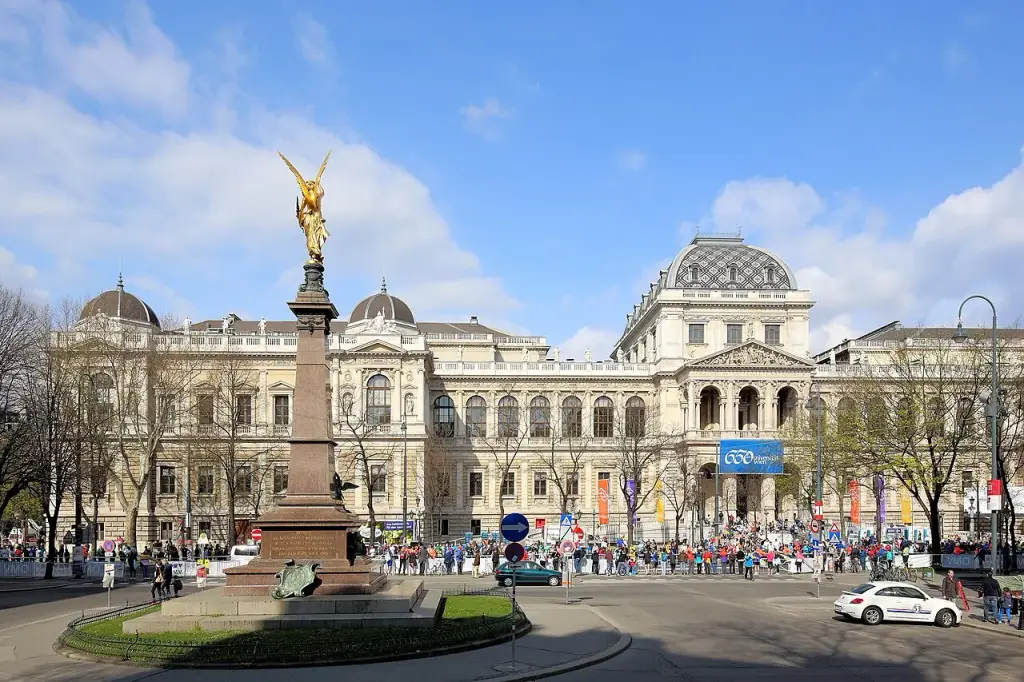
Austria · Vienna
University of Vienna
Austria's largest university, with the widest range of subjects in the country
Photo: C.Stadler/Bwag · CC BY-SA 4.0
- QS World Ranking 2027
- #140
- Founded
- 1365
- Students
- 87,000
- Bachelor's degree
- 3 years
- Acceptance rate
- Not published; admission on a recognised certificate, with a written entrance or aptitude test for many bachelor's programmes
- Typical IB offer
- At least 24 points; six subjects incl. a foreign language and maths, three at HL; IB Certificate not accepted
- Typical A-level offer
- Four subjects at C or better: language, maths, biology/physics/chemistry, humanities; three at A-level
- How admission works
- Foreign certificates must be recognised as equivalent to the Austrian Matura; an IB Diploma is treated as a Swiss-issued certificate. For non-EU applicants with an IB Diploma the university asks you to message it with your citizenship and programme to get the steps. Some programmes have an entrance or aptitude test, and the one English-taught bachelor's, Mathematical Foundations of Data Science, requires you to pass a 90-minute English test with at least 50% of the points.
- Language of instruction
- German. Bachelor's programmes are taught in German except Mathematical Foundations of Data Science, taught in English. Admission to a German-taught degree programme needs German at C1 (ÖSD, Goethe, telc C1 Hochschule, DSH-2, TestDaF 4 in all parts and others). With A2 you can apply and take German and other supplementary exams at the university's preparation programme (VWU) before the degree begins.
Worth knowing
The university dates from 1365, when it was founded as the Alma Mater Rudolphina. Anton Zeilinger, for many years a professor there and now emeritus, won the 2022 Nobel Prize in Physics.
How hard is it to get in, and why
Admission rests on a recognised school-leaving certificate and the required German; the university says there is no numerus clausus and grades are not relevant for admission. Many programmes, among them business, economics, law, psychology, biology, computer science and political science, add a written entrance test held once a year in July. The main barrier is German: C1 is needed to be admitted to a degree programme.
What it costs
Tuition
$2k per year
Students from outside the EU/EEA pay EUR 726.72 tuition plus a EUR 26.20 Students' Union fee, EUR 752.92 per semester. The annual EUR 1 453 is a calculation, 2 × 726.72 (about EUR 1 506 with the union fee), two semesters a year (winter and summer) per the university's academic calendar; the page names no intake year, and the fee is the same for every bachelor's programme. The living range is a calculation, × 12, from the university's monthly estimate for students in Austria, written for exchange students (accommodation EUR 450–700, food EUR 350, study and personal needs EUR 400–500); the Austrian student residence permit requires proof of EUR 722.58 a month (about EUR 8 671 a year) for applicants under 24 and EUR 1 308.39 from age 24, rates in force since 1 January 2026.
Living costs
$16k–21k per year
Scholarships and financial aid
The university lists a merit scholarship awarded for academic achievement to date and a research scholarship, not an entry scholarship for international applicants. The Students' Union says tuition-waiver options are limited for third-country students; the tuition fee is waived for citizens of a published list of developing countries, and Thailand is not on it.
How to apply
Applications go through the u:space portal, after the Online Self-Assessment that the application requires. For programmes without an entrance test, the last published non-EU application period for winter semester 2026/27 was 22 June to 3 August 2026; the page lists no dates for winter semester 2027/28 yet, which starts on 1 October 2027. Programmes with an entrance test have one application period a year (2 March to 4 May in 2026), a written test in July and a EUR 50 administration fee for the English programme. Documents are the full certificate with legalisation and a sworn translation unless in German or English, a list of subjects and proof of German at A2 or C1. Non-EU applicants with an IB Diploma should contact the admissions office first.
Official websiteWhat makes it special
- About 87 000 students, 188 degree programmes and 20 faculties and centres; the university calls itself Austria's largest research and educational institution.
- Mathematical Foundations of Data Science is a six-semester, 180-ECTS English bachelor's that needs no German.
- The programme page calls the mathematics faculty the place where Kurt Gödel laid the theoretical foundations of computer science.
- Programmes with an entrance test include business administration, economics, law, psychology, biology, computer science and political science.
- The winter semester starts on 1 October and the summer semester on 1 March.
About studying in Austria
Public universities such as the University of Vienna and TU Wien charge students from third countries who hold a student residence permit about €726.72 per semester, roughly €1,450 a year, plus a small student-union fee at the University of Vienna. TU Wien's bachelor's programmes last six semesters and are generally taught in German, with English mainly at master's level, so German proficiency is part of the plan. Applications go to each university directly. Check deadlines, entrance restrictions for subjects such as medicine, and work rights on the student residence permit before committing.
Teaching staff
The dossier on teaching staff for this university is still being written.
The campus in photographs
Photographs come from Wikimedia Commons under free licences; the author and licence are shown on each image.
Reviews
No reviews yet. Visited, applied, or studied here? Be the first.