South Africa · Cape Town, Western Cape
University of Cape Town
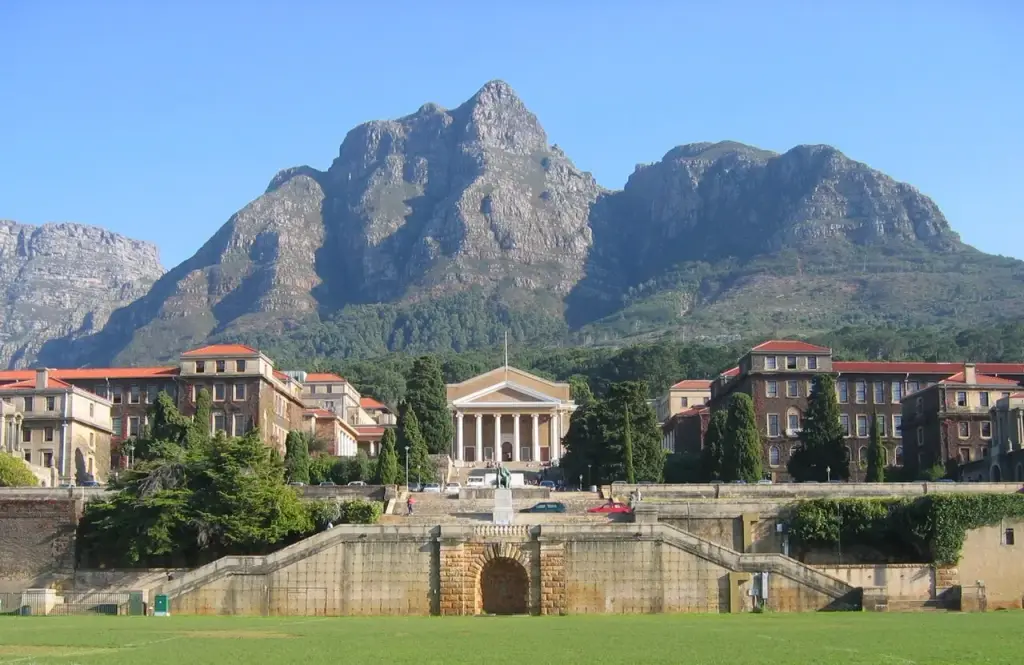
South Africa's oldest university, taught in English, on the slopes of Devil's Peak
Photo: Adrian Frith · CC BY-SA 3.0
- QS World Ranking 2027
- #184
- Founded
- 1829
- Students
- 31,000
- Bachelor's degree
- 3 years
- Acceptance rate
- Not published; applicants are ranked on school results and National Benchmark Tests, and places are limited
- Typical IB offer
- Full Diploma, 3 HL + 3 SL; Maths HL 5 or SL 6, English HL 3 or SL 5 (most degrees)
- Typical A-level offer
- 5 subjects: 3 A-levels + 2 IGCSE/AS; BCom needs Maths A-level C (or AS B)
- How admission works
- A foreign school-leaving certificate must qualify for matriculation exemption from the Matriculation Board; UCT checks this before making an offer. Applicants whose first language is not English and who have not passed English at a recognised level at an English-medium school need TOEFL iBT 88 (at least 19/19/20/22), IELTS Academic 6.5 (at least 6.0 in each part), PTE Academic 67 or an NBT Academic Literacy Plus result of Upper Intermediate, as UCT lists them. NBTs are compulsory for Commerce and Health Sciences wherever you live.
- Language of instruction
- English
UCT calls its IB and A-level table a guideline of minimum requirements that does not guarantee admission; each applicant is assessed individually. Requirements differ by programme: for example Actuarial Science asks for Maths IB 7 at HL. Health Sciences programmes, including MBChB, are open only to citizens and permanent residents of South Africa and of some SADC countries.
Worth knowing
Founded in 1829, UCT is South Africa's oldest university. Its former students include five Nobel laureates: Max Theiler, Alan Cormack, Sir Aaron Klug, Ralph Bunche and J M Coetzee.
How hard is it to get in, and why
UCT publishes minimum subject requirements for IB and A-level applicants but says meeting them does not guarantee an offer, because places are limited by capacity. Applicants to Commerce and Health Sciences must write the National Benchmark Tests wherever they live, and international LLB applicants must write the Academic Literacy part. No more than ten international applicants are accepted into the undergraduate LLB. UCT publishes no acceptance rate.
What it costs
Tuition
$9k–12k per year
Figures are for 2026, the latest UCT has published (the 2027 schedule was not out); UCT charges per course, and typical first-year fees run from R62,340 (BCom) to R110,580 (Actuarial Science). Extended and Academic Development programmes (from R46,000) are offered to South African applicants, and Health Sciences, including MBChB (R113,510), is closed to non-SADC citizens, so neither sets the range. For students from outside Africa the range is a calculation: the course fee plus the R5,600 International Administrative Fee plus the R80,400 International Term Fee, R148,340 to R196,580 a year; SADC citizens pay no Term Fee. Living is UCT's estimated minimum for board and lodging outside residence, R133,960 a year (UCT gives R147,280 for medical students only); UCT's fee handbook adds R10,000 for books and R10,000 for living expenses, local transport and sundries, not included.
Living costs
$8k per year
Scholarships and financial aid
UCT states that it offers no bursaries or scholarships to international undergraduate applicants. American citizens in full-degree study may apply for US Federal Aid (Direct Loans), and UCT is also an accredited institution for Canadian Federal Aid.
How to apply
Apply online through UCT's application portal; you may name two programmes, and non-SADC international applicants pay an application fee of R300. For the 2027 intake applications opened on 1 April 2026 and closed on 31 July 2026, so that cycle is over; UCT had not yet published dates for the next one. Last cycle, proof of English proficiency and supporting documents for international applicants (predicted grades, transcripts) were due on 30 September, final IB results from the November session on 15 January, and the deadline for an international applicant to receive an offer was 15 November, to leave time for a study visa. Offers to IB and A-level applicants are conditional on the Matriculation Board exemption, which you apply for through your faculty office before the end of your first year.
Official websiteWhat makes it special
- Six faculties: Commerce, Engineering and the Built Environment, Health Sciences, Humanities, Law and Science.
- More than 5,000 international students from over 100 countries, according to UCT's 2027 prospectus.
- Main campus on the lower slopes of Devil's Peak in the Cape Peninsula.
- Teaching and examinations are in English.
- Forty sporting codes and more than 100 student societies.
- Course-based fees: you pay for each course you enrol in, not a flat tuition.
About studying in South Africa
A Bachelor of Science at the University of Cape Town takes a minimum of three years, and Wits asks international applicants for proof of English proficiency. Applications go directly to each university online: UCT closed on 31 July 2026 for 2027 entry with a R300 application fee outside SADC, and Wits closed on 30 September for most programmes with a R100 fee. UCT charges course tuition (about R79,000 for a typical first-year BA) plus an annual International Administrative Fee of R5,600 and, for students from outside Africa, an International Term Fee of R80,400, roughly R165,000 in total for 2026. Wits charges non-SADC undergraduates double the local tuition with no registration fee. The honest caveat is paperwork and insurance: a study visa, compulsory South African medical aid at Wits, and an evaluation of foreign school qualifications by the Matriculation Board.
Teaching staff
The dossier on teaching staff for this university is still being written.
The campus in photographs
Photographs come from Wikimedia Commons under free licences; the author and licence are shown on each image.
Reviews
No reviews yet. Visited, applied, or studied here? Be the first.