
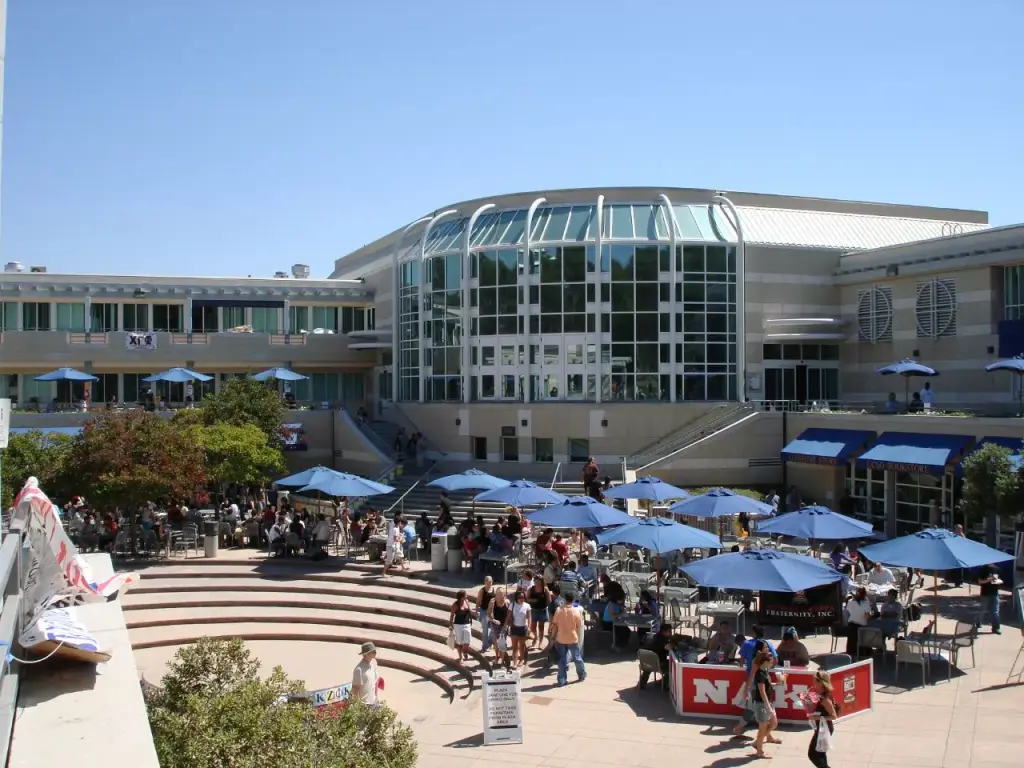
United States · La Jolla, San Diego, California
University of California, San Diego
Science-first UC campus on the Pacific, home of Scripps Institution of Oceanography
Photo: Alex Hansen · CC BY 2.0
- QS World Ranking 2027
- #81
- Founded
- 1960
- Students
- 45,000
- Bachelor's degree
- 4 years
- Acceptance rate
- 27% overall (fall 2026 admits); CDS fall 2025: 29% overall, 31% international (admitted/applied)
- Typical A-level offer
- 3 A-levels, each C or better, average at least B; plus 5 (I)GCSE incl. English at C+, average B
- How admission works
- Apply through the UC Application. For IB, the final-year courses must be passed at C or better with an overall 3.0, and IB results go to UC San Diego by 15 July. English proof for applicants from non-English schools: TOEFL iBT 4.5 (exams from January 2026; 83 before), IELTS 7, Duolingo 115, or IB English A HL 5+ / SL 6+.
- Language of instruction
- English
UC San Diego publishes no IB points threshold
Worth knowing
UC San Diego calls itself an experiment: it was founded in 1960 on about 1,200 acres of coastal woodland above the Pacific, and 16 Nobel laureates have taught there. The Scripps Institution of Oceanography is part of the university.
How hard is it to get in, and why
UC San Diego admitted 27% of about 141,700 first-year applicants for fall 2026, and the middle 50% of admits had a 4.12–4.28 GPA on UC's weighted scale. Data Science, Engineering and Public Health are selective majors, and Nanoengineering and Structural Engineering are screened, so the rate for them is far lower. Review is holistic, SAT/ACT scores are not considered, and four Personal Insight Questions of 350 words replace the essay. Non-residents, international applicants included, need at least a 3.4 GPA in the A-G courses just to be eligible.
What it costs
Tuition
$57k per year
Tuition is UC's estimate for 2027–28: $57,300 a year for a new non-resident, the same at every UC campus, and UC keeps it flat for up to six years. For comparison, the 2026 entry cohort pays $54,858 ($14,202 plus $1,386 Student Services Fee plus a $39,270 non-resident supplement). Campus fees and health insurance ($1,065 a quarter, waivable with equivalent cover) are billed on top. Living is the university's 2026–27 Common Data Set budget: $20,443 for on-campus food and housing, up to $25,327 with books ($1,203), transport ($921) and other expenses ($2,760), a sum of published lines.
Living costs
$20k–25k per year
Scholarships and financial aid
International students are not eligible for federal or state aid, and UC San Diego must see proof of funds for the visa. The one merit award its page names for non-residents is Triton Scholars ($5,000–$20,000 a year for up to four years, automatic consideration); the page does not say separately whether international students qualify, so ask the admissions office.
How to apply
One UC Application, open from 1 August, with submissions between 1 October and 30 November. You answer four of eight Personal Insight Questions (350 words each), rank four residential colleges and pick a major; Music, Theatre & Dance and Visual Arts accept an optional portfolio through the department. SAT and ACT scores are not considered. Report IB or A-level coursework on the application and send final results later: transcripts by 1 July, IB scores by 15 July.
Official websiteWhat makes it special
- Eight undergraduate residential colleges, each with its own general-education requirements; you rank your top four on the UC application, and any college lets you take any major.
- More than 140 undergraduate majors, but a 26:1 student-to-faculty ratio — it is a big research university, not a small college.
- Selective majors (Data Science, Engineering, Public Health) have limited places; the UC application lets you name an alternate non-selective major, and UC San Diego strongly recommends doing so.
- The Scripps Institution of Oceanography and the UC San Diego Health system are part of the university, and its pages count 16 Nobel laureates among its past faculty.
- Triton Scholars gives non-resident first-years $5,000–$20,000 a year without a separate application.
About studying in United States
Four-year degrees and holistic admissions: universities read essays, recommendations and a record of what you have built or led, not only grades. Applications go through the Common App by early November (early rounds) or early January; most top universities have brought back SAT or ACT scores. Sticker prices are the highest in the world, but Harvard, MIT, Yale, Princeton and a few others admit international students without looking at family income and then cover the full demonstrated need.
Teaching staff
The dossier on teaching staff for this university is still being written.
The campus in photographs
Photographs come from Wikimedia Commons under free licences; the author and licence are shown on each image.
Reviews
No reviews yet. Visited, applied, or studied here? Be the first.