
Ireland · Dublin, Leinster
University College Dublin
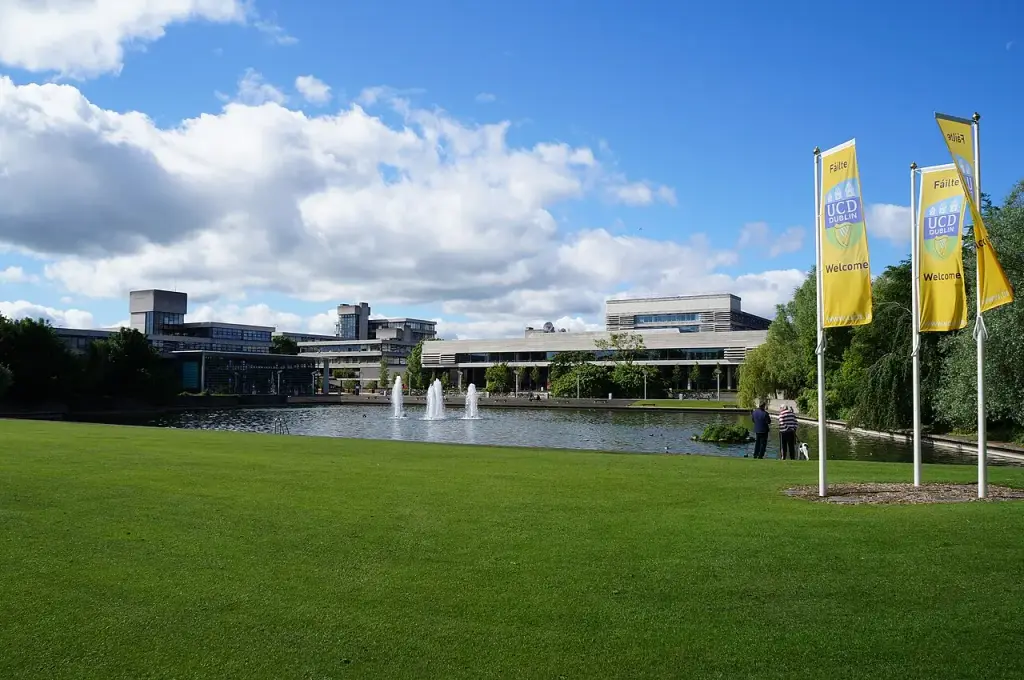
Ireland's largest university, on a 133-hectare parkland campus in Dublin
Photo: Leandro Neumann Ciuffo · CC BY 2.0
- QS World Ranking 2027
- #100
- Founded
- 1854
- Students
- 38,000
- Bachelor's degree
- 4 years
- Acceptance rate
- Not published; the entry bar is set per course
- Typical IB offer
- 24–42 points by course (Arts 24, Commerce 33, Medicine 39 + interview, Actuarial 42)
- Typical A-level offer
- CCD to A*A*A* by course (Arts CCD; Commerce AAC or ABB + AS; Medicine A*A*A + interview)
- How admission works
- Minimum for every course: the full IB Diploma with 24 or more points, or at least three A-levels at grade C plus GCSE grade C in the remaining subjects (six distinct subjects). Courses add Mathematics, science or language grades, for example HL 5 Mathematics for Economics.
- Language of instruction
- English
UCD calls its equivalences indicative and the minimum for consideration on a competitive basis. The IB table is for 2027 entry, while the A-level tables on the page are labelled 2025 and 2026 entry.
Worth knowing
UCD was founded in 1854 by John Henry Newman. It has more than 38,000 students from 152 countries, over 5,000 of them at locations outside Ireland, and calls itself Ireland's largest university.
How hard is it to get in, and why
UCD publishes an IB total for each course, and the spread is wide: 24 for Arts, 33 for Commerce, Law and Computer Science, 39 for Medicine (plus an interview) and 42 for Actuarial and Financial Studies. Several courses add Higher Level or Standard Level Mathematics grades, and Veterinary Medicine asks for 60 hours of animal-handling experience. UCD calls these figures the minimum for consideration on a competitive basis and publishes no offer rate. Overall it sits closest to Manchester.
What it costs
Tuition
$26k–73k per year
The 2027/28 non-EU fee table lists EUR 23,050 for Law and Economics, EUR 23,250 for most Arts and Humanities, EUR 23,635 for Commerce and Business, EUR 30,095 for Computer Science, Engineering and most science courses, EUR 39,520 for Veterinary Medicine and EUR 65,170 for Medicine, which is the top of the range. UCD says multi-year programmes keep the starting fee, except Veterinary Medicine, which rises annually. Living costs are a calculation from UCD's monthly estimate (April 2026) of EUR 1,735 lowest and EUR 2,445 median, times 12; UCD expects most students to be near the median. Ireland's immigration service requires proof of EUR 10,000 for a year of study.
Living costs
$23k–33k per year
Scholarships and financial aid
Global Excellence Scholarships cover 100% or 50% of tuition for a limited number of non-EU applicants who already hold an offer. UCD says the 2027/28 details will be published in early November 2026; last cycle's deadline for most regions was 31 March 2026. The International Student Scholarship is assessed automatically at the point of offer, with no application, and some programmes are excluded.
How to apply
Non-EU applicants apply directly through the course page on UCD's catalogue, not through the CAO, which serves EU-fee applicants. Applications open on 1 October for the following September and cost EUR 70; UCD recommends that visa-required students apply before 1 July and does not state a single closing date. Applicants still waiting for final results can receive a conditional offer if they submit their transcripts to date. Medicine adds an interview, and Veterinary Medicine needs the animal-handling experience described above.
Official websiteWhat makes it special
- The main Dublin campus is a parkland estate of 133 hectares.
- Liberal Arts and Sciences (IB 24) is a four-year route in which the degree subject is chosen after the first year or later; it is open to Arts, Science, Business, Engineering Science and other degrees.
- Three-year bachelor's degrees exist in Arts, Business, Social Science and Sport; Science, Law and Agriculture are four-year degrees.
- Medicine and Veterinary Medicine are open to school-leavers on the direct-entry route; Veterinary Medicine asks for 60 hours of animal-handling experience.
- Applicants who miss direct entry can consider the one-year International Foundation Year, which combines study skills, English and academic study.
About studying in Ireland
Most bachelor's courses at Trinity College Dublin take four years, and engineering and several professional courses take five. Non-EU applicants apply directly to Trinity through the page of the course, not through the CAO, which serves Irish and EU students; the general deadline for 2026 entry was 30 June, and 1 February for medicine, dental science, drama and music education. For 2027/28 non-EU first-year fees are roughly EUR 23,250 for most arts, humanities and social science courses and EUR 30,450 for most science, engineering and computer science courses, from EUR 15,510 for the cheapest course to a maximum of EUR 62,000 for medicine and dental science. The minimum IB entry is three Higher Level subjects at grade 5 and three Standard Level at grade 4, taken in one sitting, plus evidence of English. The honest caveat is cost: fees are quoted per entry year, and continuing students may face annual increases.
Teaching staff
The dossier on teaching staff for this university is still being written.
The campus in photographs
Photographs come from Wikimedia Commons under free licences; the author and licence are shown on each image.
Reviews
No reviews yet. Visited, applied, or studied here? Be the first.