
Chile · Santiago, Metropolitan Region
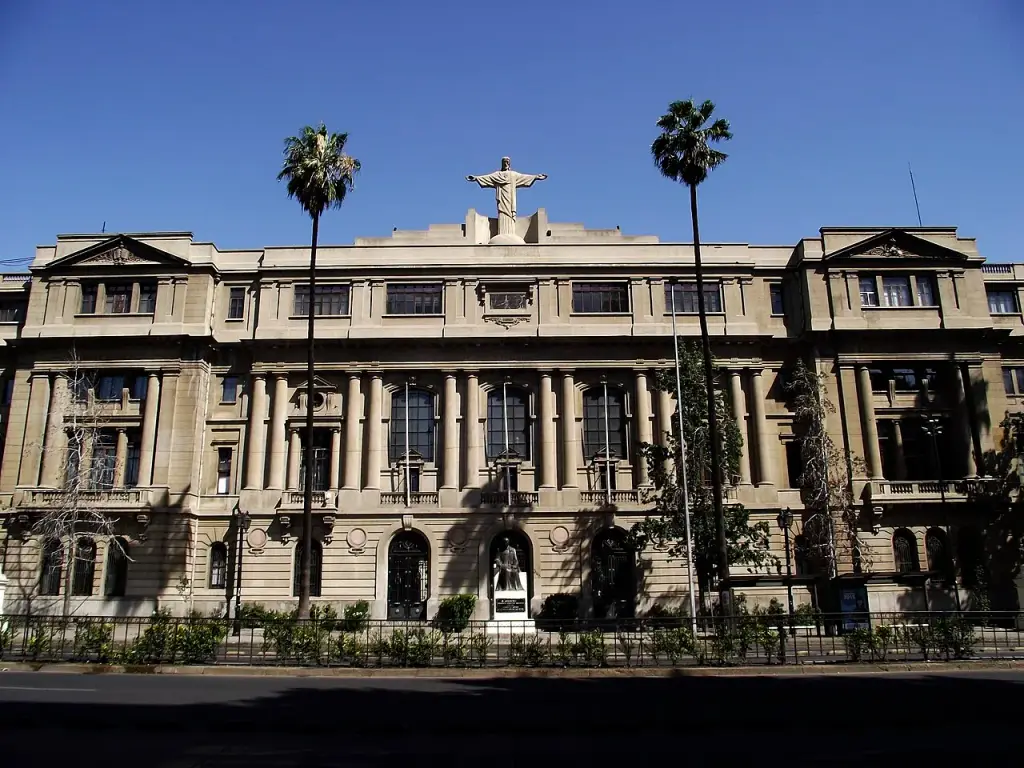
Pontificia Universidad Católica de Chile
Santiago's Catholic university, known for engineering, medicine and architecture
Photo: Sfs90 · CC BY-SA 4.0
- QS World Ranking 2027
- #119
- Founded
- 1888
- Students
- 40,000
- Bachelor's degree
- 5 years
- Acceptance rate
- Not published; the special route for foreign-school applicants offers at least one place per career
- How admission works
- Applicants who studied at least the last two years of secondary school outside Chile, the last of them no more than three years before applying, use UC's Special Admission route instead of the PAES; each career runs its own evaluation (pre-selection, subject tests and/or interviews). Documents must be apostilled (or legalised at a Chilean consulate) and include the school transcript with its grading scale, a graduation-ranking certificate (or proof that the school issues none), a motivation questionnaire and a notarised statement of no prior university study. UC recommends Spanish at about B2 (DELE, SIELE or an institutional letter) and asks for a school average of at least 5.0 (Architecture) or 5.5 (Kinesiology, Medicine, Nutrition and Dietetics, Dentistry, Psychology), or the equivalent on the home country's scale.
- Language of instruction
- Spanish (about B2 recommended for foreign applicants)
UC publishes no IB or A-level requirement and no score threshold for this route. The Spanish level is a recommendation, not a stated cut-off.
Worth knowing
UC was founded on 21 June 1888 on the initiative of Archbishop Mariano Casanova, and its first faculty was Law. In 2025 only 740 of its 32,630 undergraduates (2.3%) were foreign nationals.
How hard is it to get in, and why
A foreign-school applicant does not take the national PAES test: UC runs its own evaluation for each career, which can include a pre-selection, subject-knowledge tests and interviews. Every career offers at least one place for first-semester 2027 entry through this route, so places are few. Architecture asks for a portfolio, Medicine for a personal letter, and teaching is in Spanish.
What it costs
Tuition
$4k–11k per year
UC publishes a yearly tuition (arancel) per career, set by rector's decree and paid in ten monthly instalments from March. The 2026-entry figures run from CLP 4,140,000 (Catholic Religion Teaching) to CLP 10,720,000 (Medicine and Dentistry); Commercial Engineering is CLP 9,540,000. A single enrolment fee of CLP 195,000 (2026) is charged on top and is not included; 2027-entry figures are not yet published. UC states no separate rate for foreign students and no yearly living-cost estimate, only that applicants awaiting scholarship results should hold about CLP 500,000 per month for the first four months.
Living costs
not disclosed
Scholarships and financial aid
UC says it is attached to all Chilean state benefits, so Gratuidad and the Ministry of Education's scholarships and loans can be used there, and applying for any of them requires the FUAS socio-economic form. UC does not say whether foreign applicants qualify, and lists no scholarship of its own for this route.
How to apply
Applicants from foreign schools apply online through UC's Special Admission route, pay an application fee (CLP 107,230 in the first period, CLP 161,150 in the second, for external applicants) and upload their documents; UC then confirms by email who goes on to evaluation. For first-semester 2027 entry the application periods ran 24 August to 24 September 2026 and 28 September to 28 October 2026, so both have closed; evaluations run 16 November to 4 December 2026 and results come on 28 December 2026. UC has not yet published dates for 2028 entry. Selected foreign students must then obtain a Chilean temporary student residence and, if they lack a Chilean secondary-education licence, hand it in at enrolment.
Official websiteWhat makes it special
- Four campuses in Santiago and one in Villarrica; San Joaquín holds 25,102 of the 32,630 undergraduates (2025).
- The tuition page lists 66 undergraduate careers, including three UC College entry programmes (Arts and Humanities, Natural Sciences and Mathematics, Social Sciences).
- Programmes are long: Commercial Engineering takes 10 semesters, Civil Engineering 11 and Medicine 12.
- Foreign-school applicants can enter in March or August, though not every career has places for the August intake.
- UC has no residences of its own; foreign students must hold health insurance usable in Chile for at least the first 90 days.
About studying in Chile
Degrees at the Pontifical Catholic University of Chile (UC) are long: Commercial Engineering lasts 10 semesters and Civil Engineering 11. UC's admissions pages are in Spanish and mention no English-taught bachelor's, so assume Spanish. Foreign applicants can use the central PAES route if Chile's Ministry of Education recognises their school studies, or UC's special route for those who studied abroad: an online application, apostilled documents and a minimum school average of 5.0 on the Chilean scale or its equivalent (5.5 for medicine, dentistry and psychology), with two application periods a year. UC charges a matriculation fee of CLP 195,000 and a yearly tuition set per career, in 2026 CLP 9,540,000 for Commercial Engineering and CLP 10,260,000 for Civil Engineering, and I could not confirm whether foreigners pay a different rate. The honest caveat is the paperwork of apostilles and recognition, and a tuition bill that is not free of charge as it is in Argentina or Mexico.
Teaching staff
The dossier on teaching staff for this university is still being written.
The campus in photographs
Photographs come from Wikimedia Commons under free licences; the author and licence are shown on each image.
Reviews
No reviews yet. Visited, applied, or studied here? Be the first.