Ireland · Dublin, Leinster
Trinity College Dublin, The University of Dublin
Ireland's highest-ranked university, in the centre of Dublin, with a published IB band for every course
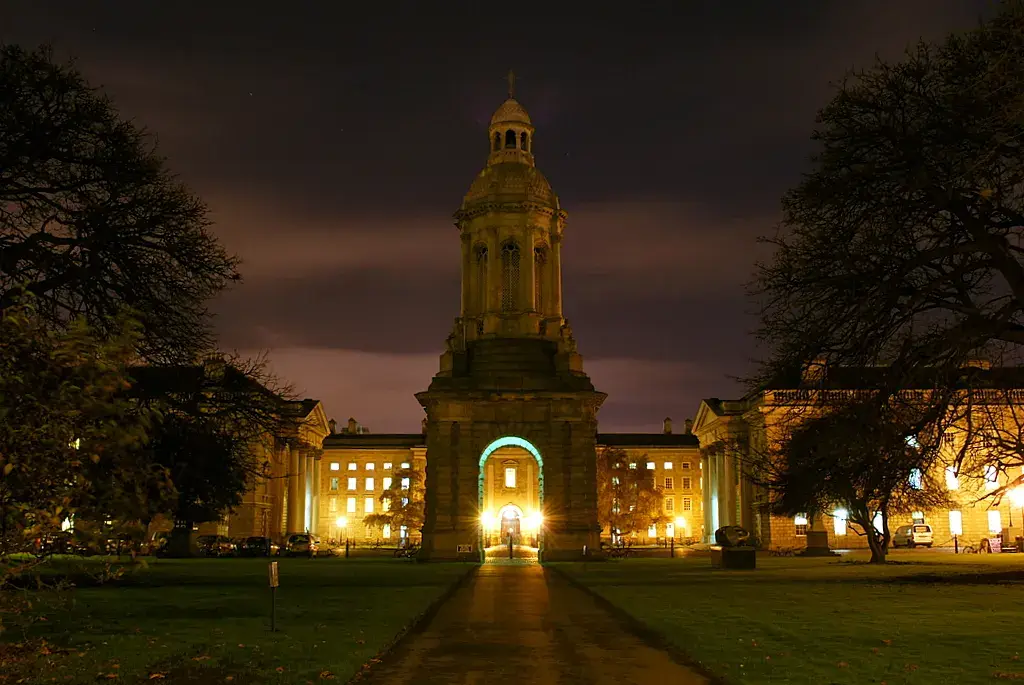
Photo: Imelda Casey · CC BY-SA 4.0
- QS World Ranking 2027
- #75
- Founded
- 1592
- Students
- 22,000
- Bachelor's degree
- 4 years
- Acceptance rate
- Not published; offers depend on the course's admission band and its subject requirements
- Typical IB offer
- 30–40 points incl. bonus points, by course; no HL below 5, no SL below 4
- Typical A-level offer
- A*A*A to ABB (three A-levels) depending on course
- How admission works
- Minimum: 3 subjects at HL grade 5 and 3 at SL grade 4, including English, Mathematics and a language other than English (the language requirement may be waived for non-native English speakers). Some courses add subjects such as HL Mathematics.
- Language of instruction
- English
Worth knowing
Trinity was created by royal charter in 1592 on the site of the former Priory of All Hallows. Its alumni include Oscar Wilde, Samuel Beckett and Mary Robinson, the former President of Ireland.
How hard is it to get in, and why
Trinity gives each course one of three bands (IB 30, 33 or 36 points, with 40 for Medicine and Dental Science) and adds subject requirements such as HL Mathematics or a science. Offers are conditional on predicted grades and the final results are checked afterwards. Medicine, Dental Science, Music Education and Drama close on 1 February, and some courses ask for an extra assessment. It sits closest to Edinburgh and Warwick, and no offer rate is published.
What it costs
Tuition
$22k–69k per year
First-year non-EU fees in the 2027/28 schedule are EUR 23,250 for most arts, humanities, business and law courses and EUR 30,450 for most science, engineering and computer science courses. The range runs from EUR 19,670 (Dental Technology) to EUR 62,000, the published maximum for Medicine and Dental Science. Trinity says fees can change each year and continuing students may face a percentage increase. Living costs are Trinity's own undergraduate estimate; Ireland's immigration service requires proof of EUR 10,000 for a year of study.
Living costs
$22k–33k per year
Scholarships and financial aid
Global Excellence Undergraduate Scholarships are worth EUR 2,000 to EUR 5,000 depending on the region and are taken off the first-year tuition fee. Medicine, dentistry, acting, engineering, natural sciences and computer science and statistics are excluded from this scheme, and the published deadline for South East Asia and Oceania was 15 July 2026 (last cycle's date).
How to apply
Applicants outside the EU, EEA, UK and Switzerland apply directly through the page of their course; the CAO serves EU students. The application asks for final results or the school's predicted scores, two references, a personal statement and proof of English for non-native speakers, and costs EUR 55 per course. The portal opens on 1 November, the general deadline is 30 June and Medicine, Dental Science, Music Education and Drama close on 1 February; Trinity's dates table still shows 2026 entry (30 June 2026 and 1 February 2026), so check the 2027 dates on the course page. Applying by 1 February gives the strongest consideration and a decision by 1 April.
Official websiteWhat makes it special
- Campus on College Green in the centre of Dublin, with about 22,000 undergraduate and postgraduate students.
- Trinity's own page ranks it 10th in the world for Nursing, 19th for English, 28th for Pharmacy and 50th for History.
- Engineering, Computer Science and several other courses are five-year programmes with a postgraduate final year.
- First-year non-EU students are prioritised for Trinity-owned or Trinity-recommended housing if they apply by the housing deadline; Trinity Hall costs about EUR 7,227 for September to June.
About studying in Ireland
Most bachelor's courses at Trinity College Dublin take four years, and engineering and several professional courses take five. Non-EU applicants apply directly to Trinity through the page of the course, not through the CAO, which serves Irish and EU students; the general deadline for 2026 entry was 30 June, and 1 February for medicine, dental science, drama and music education. For 2027/28 non-EU first-year fees are roughly EUR 23,250 for most arts, humanities and social science courses and EUR 30,450 for most science, engineering and computer science courses, from EUR 15,510 for the cheapest course to a maximum of EUR 62,000 for medicine and dental science. The minimum IB entry is three Higher Level subjects at grade 5 and three Standard Level at grade 4, taken in one sitting, plus evidence of English. The honest caveat is cost: fees are quoted per entry year, and continuing students may face annual increases.
Teaching staff
The dossier on teaching staff for this university is still being written.
The campus in photographs
Photographs come from Wikimedia Commons under free licences; the author and licence are shown on each image.
Reviews
No reviews yet. Visited, applied, or studied here? Be the first.