
Japan · Tokyo, Bunkyo and Meguro wards
The University of Tokyo
Japan's flagship national university, with admission and teaching mainly in Japanese
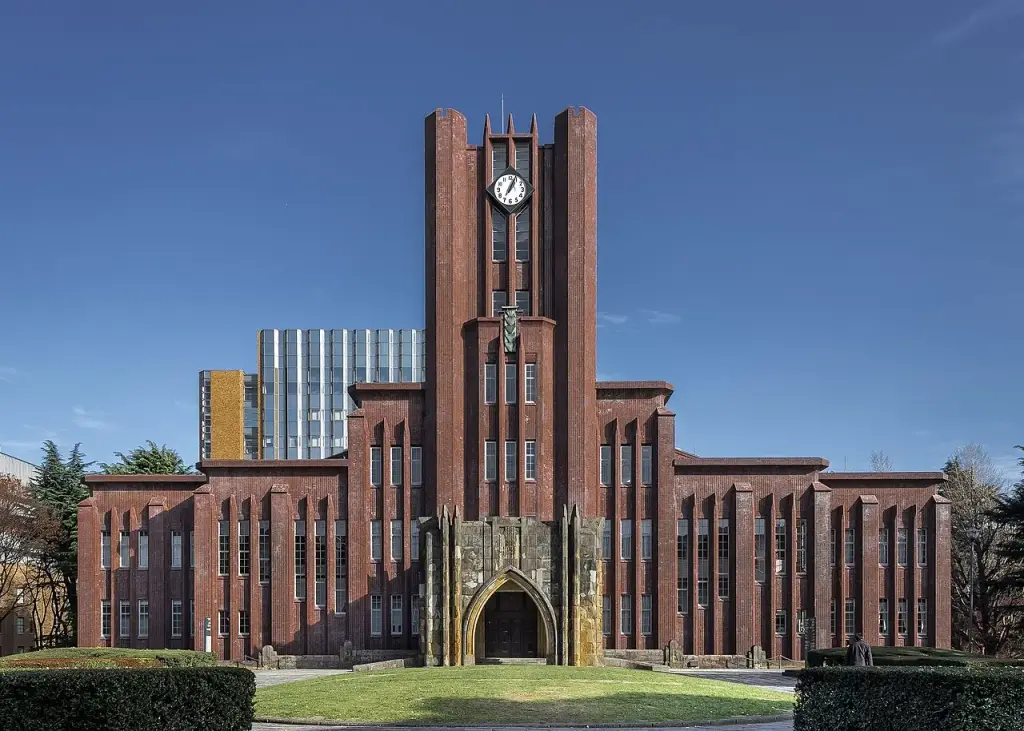
Photo: Kakidai · CC BY-SA 4.0
- QS World Ranking 2027
- #39
- Founded
- 1877
- Students
- 28,000
- Bachelor's degree
- 4 years
- Acceptance rate
- Not published; each of the six course groups takes a small number of applicants ('a few') through the foreign-school route
- Typical IB offer
- IB Diploma is an accepted basis to apply; final results for six subjects are submitted; no points cut-off published
- Typical A-level offer
- A-level or International A-level accepted as basis to apply; results submitted; no grade cut-off published
- How admission works
- Route for foreign-school graduates, 'Type 1' (privately financed international students): EJU in Japanese, a science or general subject and mathematics (June or November 2026 sitting; English or Japanese paper allowed except the Japanese-language test), plus TOEFL iBT or IELTS Academic taken within the last 2 years. Second stage: a 150-minute essay in Japanese on 25 February 2027 and an interview in Japanese on 4 March 2027. The page states no minimum EJU, TOEFL or IELTS score. Intended mainly for applicants within 5 years of leaving a foreign school.
- Language of instruction
- Japanese; the foreign-school route needs EJU Japanese and an essay and interview in Japanese. No English-taught degree for school-leavers is open now
The English-taught PEAK programme closed: September 2026 was its final recruitment, and the remaining English-taught option, the Global Science Course, is a transfer programme that starts in year 3.
Worth knowing
All undergraduates spend the first two years in the Junior Division at Komaba and then move to one of the Senior Division faculties; foreign-school applicants choose one of six course groups when applying. Foreign-school admission states that students sit in the same classes as those admitted by the general entrance exam.
How hard is it to get in, and why
The university publishes no admission rate for foreign-school graduates and lists the intake as a few places per course group. Selection is by document screening, then a 150-minute essay in Japanese and an interview in Japanese. Applicants also need EJU results, including the Japanese-language subject, and a TOEFL iBT or IELTS result. The closest anchors are NUS and HKU: a small, document-led quota, with the language as the extra filter.
What it costs
Tuition
$4k per year
The university's fee page lists undergraduate tuition at ¥642,960 a year (¥535,800 for those who enrolled in or before 2024) and an admission fee of ¥282,000, paid one time only at admission; the application fee for the foreign-school route is ¥17,000. Fees are for April 2027 entry as currently listed. The living range is a calculation: the university's international-student page puts rent at ¥80,000 to ¥100,000 a month and food at ¥50,000 to ¥60,000, and the figure is that sum times 12, without other costs.
Living costs
$10k–12k per year
Scholarships and financial aid
The fee page says students on a Japanese government (MEXT) scholarship do not pay tuition and certain other fees, and the university lists separate admission and tuition fee exemptions and scholarship pages. The page quoted does not give amounts or eligibility rules for privately financed foreign students.
How to apply
Foreign-school graduates apply by post and online, not through a central platform. For April 2027 entry the internet application form is open 16 November to 7 December 2026, and documents must arrive by 5 p.m. on 7 December 2026. The package includes transcripts for three years, IB or A-level results, a statement of reasons in Japanese, a recommendation, EJU admission ticket, TOEFL or IELTS scores sent directly, and a ¥17,000 fee. The interview and the results fall in March 2027.
Official websiteWhat makes it special
- The foreign-school route does not require the Japanese Common Test; EJU is required instead.
- Applicants from international schools are accepted only if the school holds one of the listed accreditations (WASC, CIS, ACSI, NEASC, Cognia, COBIS and others) or the applicant holds the IB Diploma or A-levels.
- Ten faculties, with the Junior Division shared by all undergraduates.
- Housing Office dormitories for international students at Mejirodai, Oiwake, Komaba and Kashiwa; about three-quarters of international students rent privately.
About studying in Japan
Four-year degrees, taught mostly in Japanese. Admission usually runs through each university, and many ask for the EJU exam, which can be taken in English or Japanese except for its Japanese-language test. English-taught bachelor's options are few: Kyoto's international undergraduate programme (iUP) uses English and Japanese, and the University of Tokyo's all-English Global Science Course is a transfer programme entering in year 3, so it does not suit school-leavers. National universities charge a standard ¥535,800 a year plus an entrance fee of about ¥282,000, but the ministry allows up to 1.2 times the standard and Tohoku will raise international tuition to ¥900,000 from 2027, so fees may rise. Private universities cost more, and the language is the real barrier outside a few programmes.
Teaching staff
The dossier on teaching staff for this university is still being written.
The campus in photographs
Photographs come from Wikimedia Commons under free licences; the author and licence are shown on each image.
Reviews
No reviews yet. Visited, applied, or studied here? Be the first.