Sweden · Stockholm
Stockholm University
Stockholm's big humanities, social-science and natural-science university, with a handful of English-taught bachelor's degrees
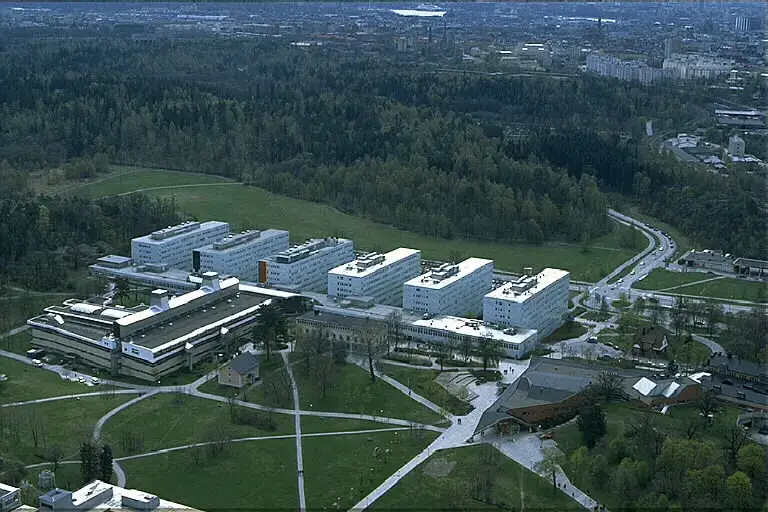
Photo: Jan Norrman · CC BY 2.5
- QS World Ranking 2027
- #167
- Founded
- 1878
- Students
- 45,000
- Bachelor's degree
- 3 years
- Acceptance rate
- Not published; entry is by eligibility under the national rules, then competition among eligible applicants
- Typical IB offer
- IB Diploma listing subjects; grade 4 minimum in each course used for specific requirements; no points bar
- How admission works
- Applications go through Universityadmissions.se. General entry: completed upper secondary school plus English 6, which IB English B SL meets when the language of instruction is not English (IELTS Academic 6.5 with no section below 5.5 also works). International Business and Politics adds Mathematics 3b or 3c and Social studies 1b; Political Science and Regional Studies adds Social studies 1b or 1a1+1a2.
- Language of instruction
- Swedish for most bachelor's programmes; seven bachelor's programmes are taught in English (International Business and Politics; Business, Ethics and Sustainability; two Latin American Studies programmes; Earth Science, distance learning; Political Science and Regional Studies; Middle Eastern and North African Studies). English 6 is required for the English-taught ones.
Neither Stockholm University nor Universityadmissions.se publishes an IB points bar or an A-level requirement. Universityadmissions.se says a minimum grade of 4 is required in an IB course for it to fulfil a specific entry requirement.
Worth knowing
Stockholm University lists just over 1,000 active exchange agreements across 50 countries. In 2025 it awarded 3,081 general bachelor's qualifications.
How hard is it to get in, and why
Applicants must meet the national general entry requirements and the programme's own course requirements, then compete with other eligible applicants for a place. No acceptance rate is published for its English-taught bachelor's programmes, and only seven such programmes exist, so the real bar is hard to judge in advance. The closest anchor is the formal-admission group (ETH, TUM): clear eligibility rules, no tests or interviews described.
What it costs
Tuition
$9k–14k per year
Stockholm states SEK 90,000 per academic year for Humanities, Social Sciences and Law and SEK 140,000 for the Sciences; some programmes have special prices in the SEK 90,000-140,000 range and a few programmes run with other universities cost more; no intake year is stated, and each programme's price is given in the course catalogue. Non-EU/EEA/Swiss applicants also pay a SEK 900 application fee. Living: Stockholm's living-costs page advises budgeting at least SEK 12,000 a month (food 2,700, housing 6,500, local travel 400, phone 400, miscellaneous 2,000); the annual SEK 144,000 is that figure times 12, a calculation. The lower figure is the Migration Agency maintenance requirement of SEK 10,656 a month, the latest amount listed, for applications made in 2026, times 12, also a calculation.
Living costs
$13k–15k per year
Scholarships and financial aid
Stockholm University and the Swedish Institute offer scholarships to master's students from outside the EU/EEA/Switzerland; no bachelor's scholarship is listed. Universityadmissions.se adds that no Swedish scholarships are available to applicants starting in the spring semester.
How to apply
Applications go through Universityadmissions.se; the first (international) round for autumn 2027 opens 16 October 2026 and closes 15 January 2027, with supporting documents and the application fee due 1 February and bachelor's results published 8 April. Universityadmissions.se says that applicants who will be awarded an IB Diploma in May 2027 should not apply to the first round, because it cannot evaluate their application without the completed IB transcript and diploma; it also says non-EU/EEA/Swiss citizens should not use the second round, as a residence permit would not arrive in time. For final-year students it lists these options: the first round for the following spring semester (few programmes start then) or the first round of next year's autumn semester. The Migration Agency does not grant residence permits for distance learning, which matters for the Earth Science programme. Autumn 2027 starts 30 August 2027.
Official websiteWhat makes it special
- 45,170 registered students in 2025, including 1,224 active doctoral students.
- Four faculties: humanities, law, social sciences and natural sciences.
- International Business and Politics is a three-year English-taught programme, with the fifth semester open to exchange studies and a degree in Business Administration.
- The tuition fee covers Swedish courses for international students, healthcare insurance (FAS) and academic support services.
About studying in Sweden
Bachelor's degrees take three years (180 credits). Applications go through the national portal Universityadmissions.se, and its first round, which closes in mid-January, is the one recommended for anyone who needs a residence permit. English-taught bachelor's programmes are few: KTH lists only one, in information and communication technology, while Lund offers some, such as International Business. Students from outside the EU/EEA and Switzerland pay tuition: Lund's International Business costs SEK 390,000 for the full three years, paid in instalments before each semester. The honest caveat is the narrow choice of English-taught bachelor's places combined with a high price.
Teaching staff
The dossier on teaching staff for this university is still being written.
The campus in photographs
Photographs come from Wikimedia Commons under free licences; the author and licence are shown on each image.
Reviews
No reviews yet. Visited, applied, or studied here? Be the first.