
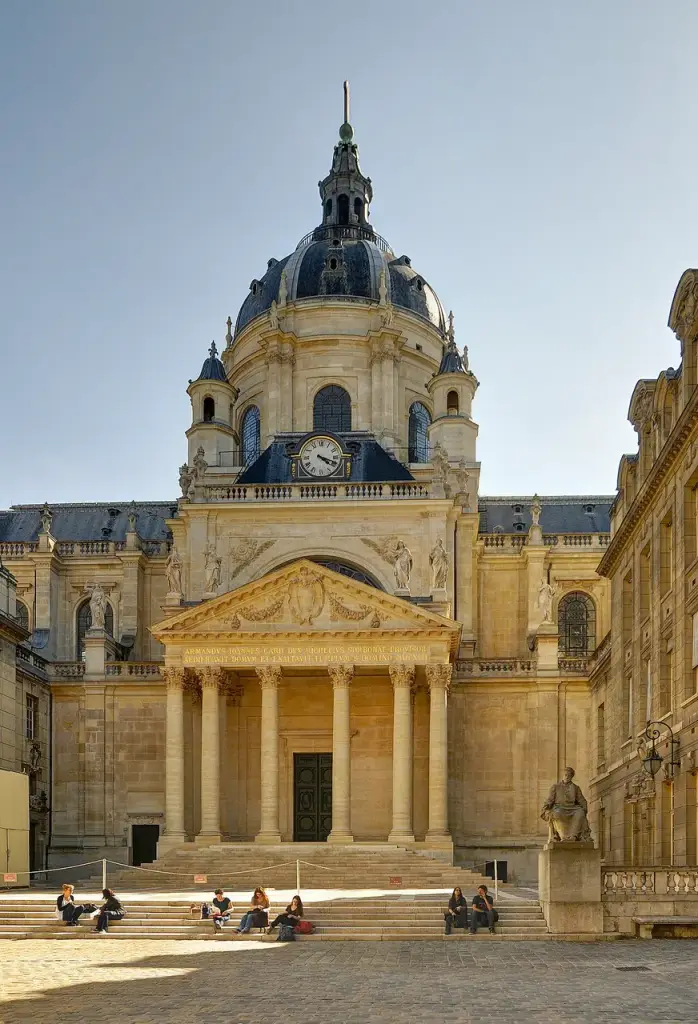
France · Paris, Île-de-France
Sorbonne University
Paris's big public research university in sciences, medicine and humanities, taught in French
Photo: Moonik · CC BY-SA 3.0
- QS World Ranking 2027
- #73
- Founded
- 2018
- Students
- 53,000
- Bachelor's degree
- 3 years
- Acceptance rate
- Not published; entry for foreign-diploma holders is by a prior-admission file (DAP)
- Typical IB offer
- International Baccalaureate is on the list of accepted foreign diplomas; no points or subject bar published
- How admission works
- Foreign-diploma holders go through a prior-admission request (DAP) and need French B2, shown by TCF, TEF or DELF. Admission decisions are due by 30 April 2027.
- Language of instruction
- French. In the first year of the bachelor's, courses are taught in French across all faculties, and a minimum of B2 is required for enrolment.
The university publishes no A-level requirement.
Worth knowing
Sorbonne University was created in 2018 by merging Paris-Sorbonne (Paris IV) and Pierre and Marie Curie (Paris VI), while the Sorbonne name goes back to 1257. It is the top French university in ocean sciences, with three marine stations.
How hard is it to get in, and why
The first-year licence is open to applicants whose diploma gives access to higher education in France, with a French level of at least B2; the university publishes no quota or grade bar for the DAP. Teaching is in French across all faculties in the first year, so French is the real filter.
What it costs
Tuition
$200–3k per year
The national bachelor's fee for 2026/27 is €178; Campus France gives €2 902 as the differentiated licence rate for non-EU students, which is the top of the range. Sorbonne's governing board adopted an exemption policy on 7 July 2026 under which it can exempt every non-EU student who applies and meets its criteria, and states that all non-EU students will pay the same tuition fees as other students, so the fee actually paid may be €178 (the CVEC contribution is extra). Living: the figure is the visa minimum of €877,50 a month multiplied by 12 (a calculation); it is a floor, not a typical budget, and Sorbonne publishes no total budget of its own.
Living costs
$12k per year
Scholarships and financial aid
The main aid is the exemption from differentiated fees: automatic for holders of French-government or means-tested grants, otherwise on application to an exemption committee that weighs financial resources, health, distance from family and similar factors. The university says it can exempt every non-EU student who applies and meets the criteria. It does not state a scholarship for non-EU bachelor's students beyond this.
How to apply
A non-EU student with an IB Diploma who lives abroad applies through the prior-admission request (DAP) for the first year of the licence: through Études en France if the country is covered (Thailand is on Campus France's list), otherwise through the French embassy. The DAP lets an applicant name three universities, which review the file at the same time. Campus France's calendar for 2027-28 runs from 1 October to 15 December 2026, with answers by 30 April 2027 and the student's reply by 31 May 2027; the Faculty of Science and Engineering states a DAP window to 15 January 2027, but for an applicant in Thailand, where Études en France applies, the Campus France date of 15 December 2026 is the one to plan for. Parcoursup is only for European applicants and holders of a French or European baccalaureate.
Official websiteWhat makes it special
- More than 53 000 students, 11 500 of them international.
- Three faculties: Arts and Humanities, Health, and Science and Engineering.
- 37 bachelor's degrees with 45 options of bi-disciplinary studies, and 240 master's programmes.
- 135 research units and 3 marine stations.
- Part of the 4EU+ Alliance and the Sorbonne University Alliance, with more than 1 500 Erasmus+ exchange agreements.
About studying in France
The licence takes three years, and applicants from outside the EU who live abroad go through Campus France's Études en France procedure; courses are taught mainly in French, so a French-language certificate is part of the file. Public institutions charge non-EU students a differentiated fee, roughly €2,900 a year for a licence in 2026/27, as published by Campus France. Institutions may waive part of it, but decree 2026-385 of 19 May 2026 now caps these exemptions at 30% of the students concerned in 2026/27, falling to 25% in 2027/28 and 20% from 2028, so do not count on a waiver. A student visa allows up to 964 hours of work a year, and Paris rents are the main cost.
Teaching staff
The dossier on teaching staff for this university is still being written.
The campus in photographs
Photographs come from Wikimedia Commons under free licences; the author and licence are shown on each image.
Reviews
No reviews yet. Visited, applied, or studied here? Be the first.