
South Korea · Seoul and Suwon
Sungkyunkwan University
A large private Seoul university with a separate English-track entry for international undergraduates
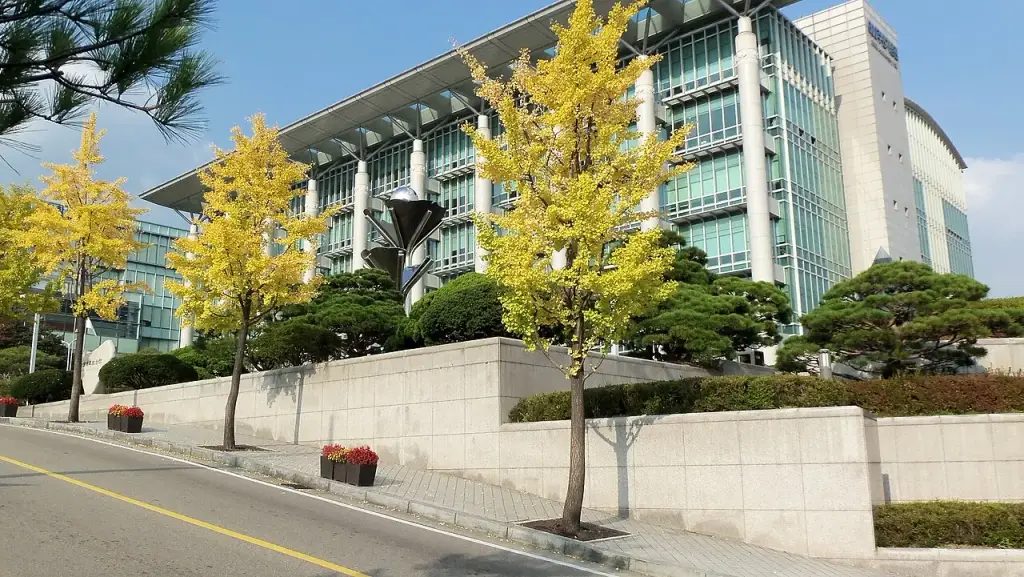
Photo: Christian Bolz · CC BY-SA 3.0
- QS World Ranking 2027
- #108
- Founded
- 1398
- Students
- 36,000
- Bachelor's degree
- 4 years
- Acceptance rate
- Not published; international selection is 100% document evaluation, with an optimal number of places set by each admission unit
- Typical IB offer
- IB accepted as optional academic reference; no points cut-off published
- Typical A-level offer
- A-level accepted as optional academic reference; no grade cut-off published
- How admission works
- Two tracks. The English Track needs an official English test (TOEFL iBT, IELTS, TEPS, TOEIC and similar); the guide gives no minimum score for admission, and applicants from English-speaking countries or with all middle and high school there are exempt. The only threshold comes later: English-track majors require IELTS 6.5 or TOEFL iBT 4.5 (80 on tests taken before 21 January 2026) by the second year. The Korean Track asks for TOPIK or a Korean course certificate, but applicants without them can still get a preliminary offer. Applicants and both parents must be non-Korean citizens.
- Language of instruction
- Two tracks: an English Track in a few units (Global Economics, Global Business Administration, Human Science and Society, several engineering majors, computer science, biomedical engineering) and a Korean Track needing TOPIK level 4 to choose a major and level 5 to graduate
IB, A-level, AP and SAT results are listed only as optional supporting documents, and SKKU states no points threshold for them.
Worth knowing
SKKU traces its origins to Sungkyunkwan, the national academy founded in 1398 at the start of the Joseon dynasty. It now has two campuses, a Humanities and Social Sciences campus in Seoul and a Natural Sciences campus in Suwon.
How hard is it to get in, and why
SKKU publishes no admit rate for international applicants. Selection is by document evaluation alone: school grades, other achievements, language proficiency and extracurriculars. The English Track asks for an official English test with no minimum score stated, while the Korean Track lets applicants without TOPIK receive a preliminary offer and convert it later by reaching TOPIK level 4. The closest anchor is Amsterdam-style formal admission: the filter is language and fit, not a published cut-off.
What it costs
Tuition
$8k–12k per year
SKKU publishes only the first-semester tuition of 2026 freshmen, including a KRW 198,000 entrance fee, and says it is subject to change for 2027: KRW 5,380,000 for humanities, social sciences, business administration and human science and society; KRW 6,212,000 for natural sciences and sport science; KRW 6,990,000 for engineering, electronic and electrical engineering, biomedical engineering, computer science and film, theatre and fashion; KRW 7,219,000 for Exploratory Studies; KRW 7,412,000 for Global Economics; and KRW 8,264,000 for Global Business Administration. The yearly tuition range is a calculation: two semesters (the academic year has a spring and an autumn semester) at each first-semester figure minus the entrance fee, from 2 x 5,182,000 to 2 x 8,066,000. The living figure is also a calculation and covers housing only, no meals: the Seoul campus dormitory daily rate for autumn 2026, KRW 12,200 (double room, type B) to KRW 22,200 (single room), times 365 days.
Living costs
$3k–6k per year
Scholarships and financial aid
Admission scholarships of 10% to 100% of tuition are given to applicants with outstanding results, for the first semester only, with no separate application. English-test scholarships for the first semester cover 100% of tuition at IELTS 8.0 or TOEFL iBT 5.5 and 50% at IELTS 7.0 or TOEFL iBT 5.0. The SKKU Global Leader Scholarship gives 50% of tuition to nominated freshmen who keep a 3.5 GPA with 12 credits a semester.
How to apply
Apply online to SKKU's international undergraduate admissions, then post or bring the original documents; the application fee is KRW 150,000. For the March 2027 start, the second round runs from 4 November to 13 November 2026 (17:00 KST) with documents due by 27 November 2026 and results on 8 January 2027. The guide marks which units also admit in the fall 2027 intake but gives no fall dates. Evaluation is 100% document-based, a personal statement is optional, and the guide says the Korean version prevails if the English differs.
Official websiteWhat makes it special
- As of 1 April 2026 the university reports 35,991 students, counting 6,313 on leave: 25,908 undergraduates and 10,083 graduate students.
- English-track students need no TOPIK for major placement, course registration or graduation.
- Engineering, computer science and biomedical engineering on the English Track are taught on the Natural Sciences campus in Suwon; Global Economics, Global Business Administration and Human Science and Society are on the Seoul campus.
- Students may combine up to three majors, except in Global Economics, Global Business Administration and Biomedical Engineering.
- Several engineering programmes are certified by the Accreditation Board for Engineering Education of Korea (ABEEK).
About studying in South Korea
Four-year degrees, with applications made to each university directly. Study in Korea says a regular programme generally expects TOPIK level 3 on admission and level 4 to graduate, though an English test can be accepted instead for admission, and some universities run English-taught tracks or faculties; roughly 30% of courses at internationalised universities are in English, mostly beyond the first years. The guidebook puts bachelor's tuition at roughly KRW 5 to 7 million per semester, but it varies by university, so check the one you want. The practical catch is Korean outside the English tracks and the amount of coursework taught in it.
Teaching staff
The dossier on teaching staff for this university is still being written.
The campus in photographs
Photographs come from Wikimedia Commons under free licences; the author and licence are shown on each image.
Reviews
No reviews yet. Visited, applied, or studied here? Be the first.