
South Korea · Seoul, Gwanak-gu
Seoul National University
Korea's flagship national university, with a document-review route for non-Korean applicants
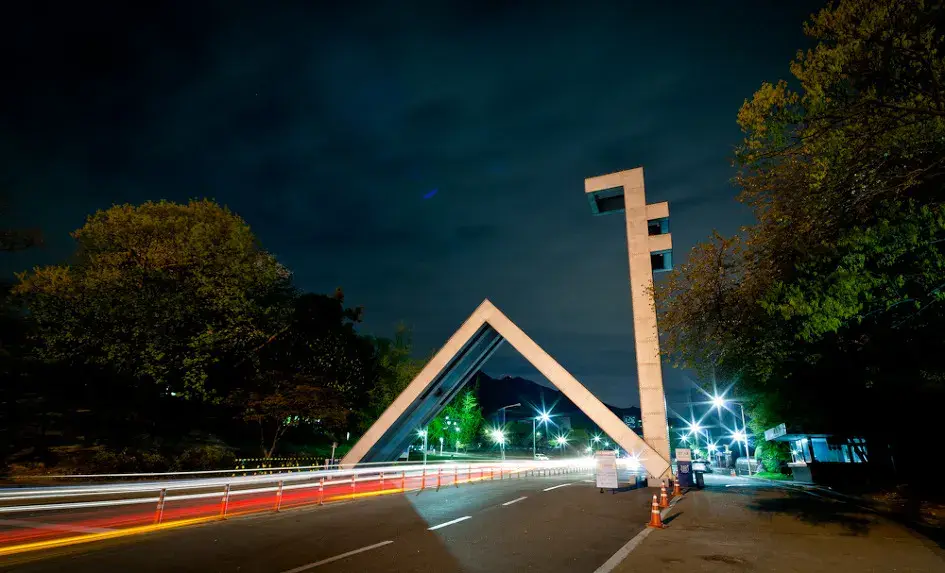
Photo: Deuterium 001 · CC BY 3.0
- QS World Ranking 2027
- #38
- Founded
- 1946
- Students
- 31,000
- Bachelor's degree
- 4 years
- Acceptance rate
- Not published: the guide says the number of applicants and the acceptance rate will not be disclosed
- How admission works
- Route for applicants and parents who are all non-Korean citizens (International Admissions I): document review, no minimum IB or A-level grade stated. Proof of language is required: TOPIK level 3 (or Korean level 4 at a Korean university language centre), or TOEFL iBT 80 (4.0 on the scale used from 21 January 2026), IELTS Academic 6.0 or TEPS 269; schooling entirely in Korean or English is also accepted. A high school transcript is required even with final IB or A-level results.
- Language of instruction
- Mostly Korean; English-taught courses depend on the department, which the university tells applicants to ask directly. Proof of Korean or English is required at application
The university publishes no IB or A-level requirement. IB and A-level results, including predicted ones, can be uploaded as optional test evidence.
Worth knowing
SNU's guide states that the number of applicants and the acceptance rate for international admissions will not be disclosed. Its Gwanak campus is listed at 4,108 thousand square metres, the largest of its five campuses by area.
How hard is it to get in, and why
The university publishes no admission rate and no quota for the international route; its guide says students are admitted without a specific quota and that applicant numbers and the acceptance rate are not disclosed. Selection is a comprehensive document review (transcripts, personal statement and study plan, a recommendation letter), with an online interview only on the track for applicants who studied entirely abroad. Applicants also need proof of Korean or English. The closest anchors are NUS and HKU: a holistic, document-led selection at a national flagship with no published cut-offs.
What it costs
Tuition
$4k–8k per year
The international admissions guide lists undergraduate tuition by college for the 2026 academic year, from KRW 2,442,000 (humanities, business) to KRW 5,038,000 (medicine, the four years after two years of pre-medicine), and says the table may change; the university's own title for the table is first semester. The yearly range is a calculation: SNU says tuition is paid twice a year, before each semester, so the figures are those amounts times 2. Medicine becomes an integrated six-year programme from 2027, so its fees may differ from the table. Living is a calculation, housing only: the Gwanak residence halls charge KRW 143,000 to 284,400 a month, times 12, plus a deposit of one month's fee; meals are not included.
Living costs
$1k–3k per year
Scholarships and financial aid
The application form has a tick box to apply for a scholarship, and the guide points to the Office of Global Affairs scholarship finder. The guide gives no amounts or eligibility rules for newly admitted students, so ask the Office of Global Affairs (intlscholarship@snu.ac.kr) before relying on funding.
How to apply
Applications go through the SNU Office of Admissions website, with a KRW 70,000 application fee, and the department cannot be changed after payment. The guide asks for a personal statement and study plan, a recommendation letter submitted online by the recommender, transcripts, and proof of Korean or English. The Spring 2027 round (March 2027 entry) ran from 6 to 9 July 2026 with results on 20 November 2026, so applications are closed. The university offers both spring and fall intakes; the newest guide is for Spring 2027, and the earlier Fall 2026 round took applications on 3 to 5 March 2026.
Official websiteWhat makes it special
- 17,439 undergraduates, out of 30,638 enrolled students in total.
- Two tracks: International Admissions I (neither the applicant nor the parents are Korean citizens) and II (the applicant studied entirely abroad, with an online interview).
- Student Residence Halls on the Gwanak campus: 21 halls for about 5,700 students; the Global buildings are allocated between Korean and foreign students at 4:6.
- Exchange agreements: 268 institutions in 46 countries at university level.
- Some admitted students sit a Korean proficiency test in February, and the result can restrict course choice in their department.
About studying in South Korea
Four-year degrees, with applications made to each university directly. Study in Korea says a regular programme generally expects TOPIK level 3 on admission and level 4 to graduate, though an English test can be accepted instead for admission, and some universities run English-taught tracks or faculties; roughly 30% of courses at internationalised universities are in English, mostly beyond the first years. The guidebook puts bachelor's tuition at roughly KRW 5 to 7 million per semester, but it varies by university, so check the one you want. The practical catch is Korean outside the English tracks and the amount of coursework taught in it.
Teaching staff
The dossier on teaching staff for this university is still being written.
The campus in photographs
Photographs come from Wikimedia Commons under free licences; the author and licence are shown on each image.
Reviews
No reviews yet. Visited, applied, or studied here? Be the first.