Germany · Aachen, North Rhine-Westphalia
RWTH Aachen University
Germany's engineering heavyweight, with no tuition even for non-EU students
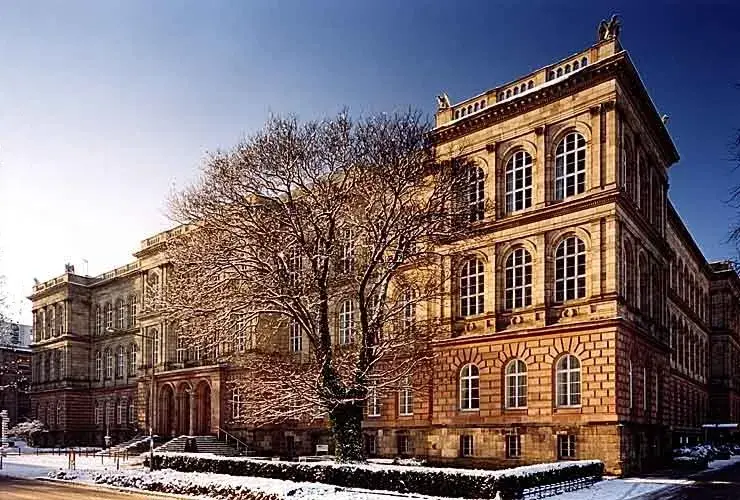
Photo: Hendrik Brixius · CC BY-SA 3.0
- QS World Ranking 2027
- #104
- Founded
- 1870
- Students
- 44,000
- Bachelor's degree
- 4 years
- Acceptance rate
- Not published; some subjects are free of admission limits, the rest select by grade average
- Typical IB offer
- Diploma: 6 subjects incl. 2 languages, science, maths, social science; each grade 4+, HL maths or science
- Typical A-level offer
- 3 A-levels at grade C or better; subject conditions by field (technical: Maths plus one science)
- How admission works
- A foreign certificate must convert to a German average of 2.5 or better; below that, TestAS is required (always for medicine and dentistry). If the certificate is not recognised for direct entry, the route is a Studienkolleg and its Feststellungsprüfung. Applications go through RWTHonline.
- Language of instruction
- German: every bachelor's programme is taught in German, and C1 is required at enrolment; some programmes, such as Computer Science, also ask for English at B2.
RWTH publishes no IB points cut-off; the IB conditions are its recognition rules for the school certificate, and the 2.5 average is a minimum for non-EU applicants, not a typical admitted profile.
Worth knowing
In winter semester 2025/26, 15,881 of RWTH's 44,382 students hold a foreign citizenship, 36 percent and the highest share on record. They come from 141 countries, led by China, India and Turkey.
How hard is it to get in, and why
RWTH publishes no acceptance rate. Mechanical Engineering, for example, has no numerus clausus, but a school certificate must convert to a German average of 2.5 or better, or TestAS must make up for it. The real barrier is language: every bachelor's programme is taught in German and C1 is required at enrolment. Mechanical Engineering also requires a six-week pre-study internship and a self-assessment.
What it costs
Tuition
$800 per year
RWTH charges no tuition to non-EU students, only a semester contribution, which the student body lists at €375.19 for winter semester 2026/27. Two semesters at that rate come to about €750 a year; the summer-semester rate differs slightly. The living range runs from RWTH's own minimum of €1,100 a month to €1,340 a month, the sum of the upper ends of its cost table; both sit above the German student-visa minimum of €992 a month (€11,904 a year).
Living costs
$15k–18k per year
Scholarships and financial aid
RWTH has no tuition to cover. Its International Office offers a Degree Completion Scholarship of €500 a month for one to five months to degree-seeking international students in the last twelve months of study who are in financial hardship; applications reopen in 2027. The International Office also lists a scholarship for particularly involved international students and an equal-opportunity scholarship, and international students can apply for the Deutschlandstipendium.
How to apply
International applicants apply online through RWTHonline; for winter semester 2026/27 the portal opened on 4 May 2026 and the deadline for restricted subjects was 15 July 2026. RWTH's standing deadlines are 1 May to 15 July for subjects with admission limits and 1 May to 20 October for the rest; dates for 2027 entry are not yet published, so treat these as last year's pattern. German at C1 is shown at enrolment, so the application can go in before the certificate. Some programmes require a pre-study internship or a SelfAssessment before enrolment.
Official websiteWhat makes it special
- Mechanical Engineering is the largest faculty, with about 10,771 students; a new Faculty of Computer Science started in winter semester 2025/26 with 4,425.
- The bachelor's in Mechanical Engineering has a standard period of study of seven semesters (210 ECTS) and no admission limit.
- The semester contribution includes a Germany-wide semester ticket for public transport.
- RWTH puts its minimum cost of living at €1,100 a month and notes that the housing market in Aachen is tight.
- The International Office awards a Degree Completion Scholarship of €500 a month to international students in their final phase.
About studying in Germany
Public universities are close to free for most students; Bavaria, where TU Munich sits, has introduced a fee for students from outside the EU, still a fraction of Anglo-American prices. Most bachelor's programmes are taught in German (level C1 is expected), with a growing number in English. Admission for an IB Diploma is largely formal, and the real test is keeping up with a demanding, self-directed course.
Teaching staff
The dossier on teaching staff for this university is still being written.
The campus in photographs
Photographs come from Wikimedia Commons under free licences; the author and licence are shown on each image.
Reviews
No reviews yet. Visited, applied, or studied here? Be the first.