
France · Paris, Île-de-France
Université PSL (Paris Sciences et Lettres)
A federation of elite Paris schools (ENS, Mines Paris, Dauphine and others) with small, selective undergraduate programmes
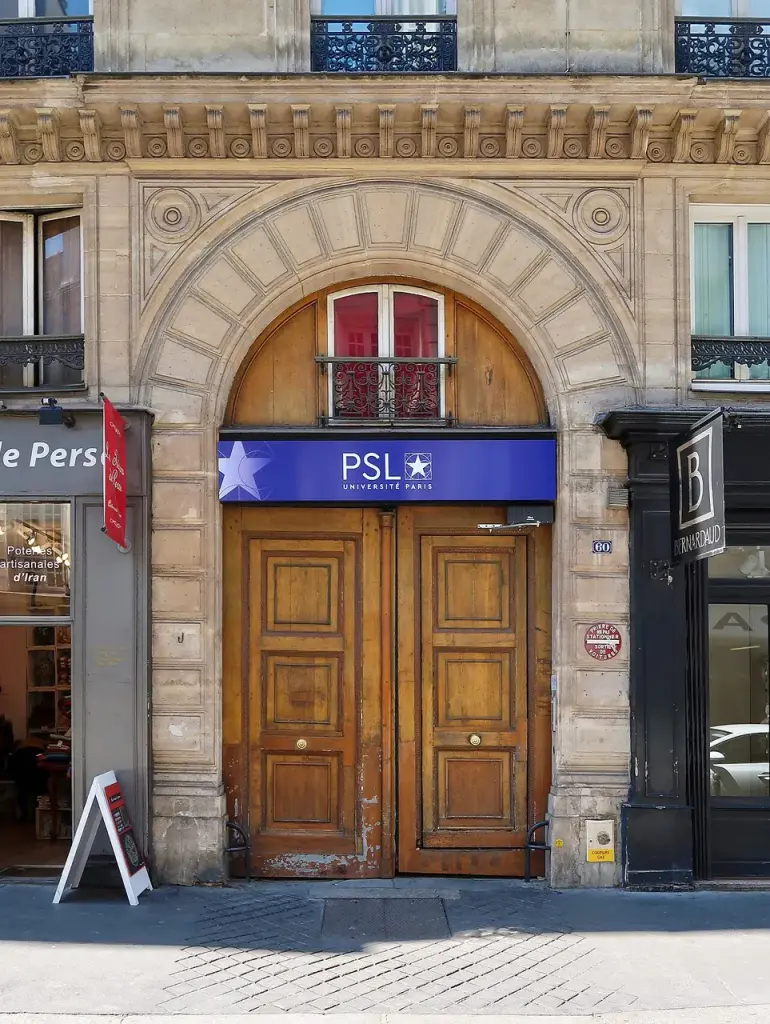
Photo: Celette · CC BY-SA 4.0
- QS World Ranking 2027
- #34
- Founded
- 2010
- Students
- 17,000
- Bachelor's degree
- 3 years
- Acceptance rate
- Not published for PSL as a whole; PSL's FAQ gives a selectivity rate of 4% for the Collège Sciences, Humanités & Société licences (about 240 first-year places, 2026), and the International Bachelor in AI reports about 500 applications for 55 first-year places (2026 entry)
- How admission works
- CPES asks for a French certificate at DALF C1 level if French is not the country's official language; Sustainability Sciences pages give French as C1 in one place and as B2 required with C1 recommended in another, and English B2; the International Bachelor in AI asks for English C1 and an advanced maths curriculum (limits, differentiation and integration, probability, complex numbers).
- Language of instruction
- French in CPES and most programmes; Sustainability Sciences is bilingual French/English with more English each year; the International Bachelor in AI is taught entirely in English (English C1, no French needed).
The university publishes no IB or A-level requirement.
Worth knowing
The first year of the CPES is taught at Lycée Henri-IV by preparatory-class teachers, university teachers and researchers, and the second year moves to PSL schools such as ENS, Mines Paris and Dauphine. Optical practicals take place at the Paris Observatory in Meudon. From the second year students can take optional courses at NYU Paris.
How hard is it to get in, and why
Undergraduate entry is selection on a file: school transcripts, a motivation letter and, for Sustainability Sciences, a 20-minute online interview. The Sustainability Sciences FAQ says admission is not based on an average grade, and its intake is only 30 students. French-taught programmes ask non-francophone applicants for a French certificate. Places are few.
What it costs
Tuition
$200–22k per year
Fees depend on the programme. CPES and Sustainability Sciences list €178 a year on pages labelled 2025/26, plus the €105 student contribution (CVEC); those pages give no rate for 2027 entry, and Campus France's national licence rate for non-EU students is €2 902 (2026/27). Dauphine-PSL's Sciences des organisations licence charges non-EU tax residents €2 349 (2026-27), and the International Bachelor in AI charges €19 500 for non-EU tax residents (2026-27 entry). Living: PSL's Welcome Desk advises €1 300–1 600 a month in the Paris region; the range is that figure multiplied by 12 (a calculation), above the visa minimum of €877,50 a month.
Living costs
$18k–22k per year
Scholarships and financial aid
The International Bachelor in AI exempts holders of a France Excellence scholarship (BFE) from tuition, and its fee schedule says Eiffel, AEFE Excellence-Major and foreign-government scholarships give no exemption. The Sustainability Sciences page mentions need-based scholarships without giving amounts. Dauphine-PSL exempts holders of French-government and CROUS grants.
How to apply
A student from outside the EU who lives in a country covered by Études en France, as Thailand is on Campus France's list, and holds a foreign diploma applies through Campus France for Sustainability Sciences, the International Bachelor in AI and the Dauphine-PSL licences; the window for September 2027 entry is 1 October to 15 December 2026. CPES is the exception: all candidates apply on Parcoursup, which PSL expects to open in mid-January 2027 with the choices deadline in mid-March (dates to be confirmed). Sustainability Sciences adds a 20-minute online interview, and the International Bachelor in AI scores academic results at 75% of the file. Admitted students who need a visa apply to the consulate afterwards.
Official websiteWhat makes it special
- About 17 000 students, 2 900 researchers and 140 laboratories.
- CPES: a three-year multidisciplinary licence with tracks in Sciences, Economics, Society & Law, and Humanities & Society, and a double major from the second year.
- International Bachelor of Science in AI: taught in English, 55 first-year places in 2026, about 90 planned for 2027.
- Sustainability Sciences: bilingual bachelor with two majors, Environmental Sciences and Economics and Social Sciences; 30 places in year one.
- Dauphine-PSL runs separate licences in law, management, applied economics, social sciences, maths and computer science.
About studying in France
The licence takes three years, and applicants from outside the EU who live abroad go through Campus France's Études en France procedure; courses are taught mainly in French, so a French-language certificate is part of the file. Public institutions charge non-EU students a differentiated fee, roughly €2,900 a year for a licence in 2026/27, as published by Campus France. Institutions may waive part of it, but decree 2026-385 of 19 May 2026 now caps these exemptions at 30% of the students concerned in 2026/27, falling to 25% in 2027/28 and 20% from 2028, so do not count on a waiver. A student visa allows up to 964 hours of work a year, and Paris rents are the main cost.
Teaching staff
The dossier on teaching staff for this university is still being written.
The campus in photographs
Photographs come from Wikimedia Commons under free licences; the author and licence are shown on each image.
Reviews
No reviews yet. Visited, applied, or studied here? Be the first.