
Australia · Sydney, New South Wales
Macquarie University
Sydney's Macquarie Park campus university with wide business, IT and social-science teaching
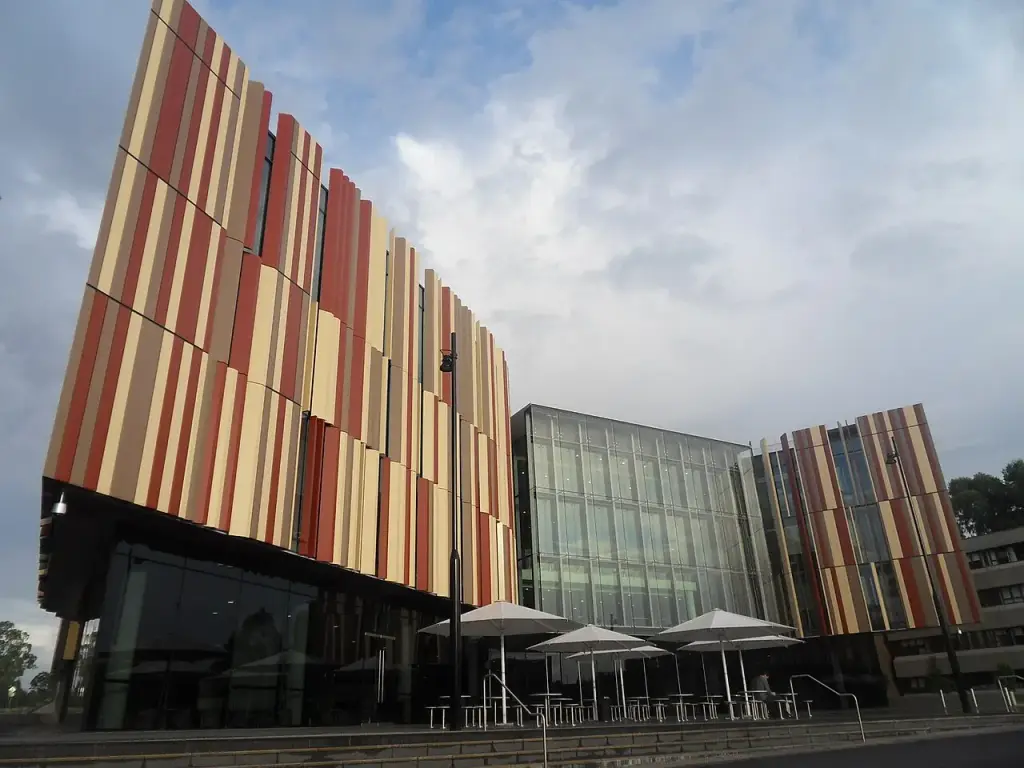
Photo: Mw12310 · CC BY-SA 3.0
- QS World Ranking 2027
- #126
- Founded
- 1964
- Students
- 46,000
- Bachelor's degree
- 3 years
- Acceptance rate
- Not published; admission by a selection rank for each course
- Typical IB offer
- 24–36 points by course (Arts, Education 24; Commerce, Engineering 28; Laws 32; Actuarial Studies 36)
- Typical A-level offer
- 7–14 points from the best three A-levels (A*=6 to E=1); Arts 7, Commerce 9, Laws 13, Actuarial Studies 14
- How admission works
- The IB score is the final aggregate of six subjects including bonus points, with at least three at Higher Level. Applicants outside Australia apply directly online or through an authorised agent; UAC is only for IB sat in Australia. English: IELTS 6.5 (no band below 6.0) for most degrees, 7.0 for Laws and 7.5 for Education.
- Language of instruction
- English
The scores come from Macquarie's international entry table of July 2026. Its 2027 onshore guide gives higher indicative IB scores (26–39) for IB sat in Australia.
Worth knowing
Macquarie's Wallumattagal campus covers 126 hectares of parkland in Macquarie Park, a hi-tech precinct. In 2025 it had 46,458 students, of whom 12,206 were international, from 117 countries.
How hard is it to get in, and why
Macquarie gives each degree an international selection rank and converts it to IB points. Arts and Education need IB 24, Commerce and Engineering 28, Laws 32 and Actuarial Studies 36. There are no entrance exams, and the rank is a minimum, not a guarantee.
What it costs
Tuition
$28k–44k per year
Macquarie's 2027 onshore international student guide lists indicative annual fees of A$40,400 (Education) to A$62,375 (the highest-fee health degree). Fees are set per credit point, reviewed each year and may rise; a commencement fee of A$16,000 to A$23,500 is taken off the first session. Living costs: Macquarie lists weekly rent for a room of A$370 to A$700 (a 1-bedroom apartment is A$700 to A$900), groceries of A$100 to A$250, utilities of A$30 to A$50 and an Opal weekly cap of A$50; the sum of the top values for a room, A$54,600 over 52 weeks, is a calculation and not a figure Macquarie publishes; the student-visa requirement of A$29,710 sets the lower bound.
Living costs
$21k–38k per year
Scholarships and financial aid
Macquarie says it awards more than A$6 million in scholarships and grants each year. The Vice-Chancellor's International Scholarship is merit-based and worth up to A$10,000 towards tuition. Country and regional scholarships for select countries are assessed automatically with the course application; the guide does not say whether Thailand is among them.
How to apply
Applicants outside Australia apply directly to Macquarie online or through an authorised agent; UAC is used only by students completing the IB in Australia. Each degree has an international selection rank, converted into the minimum IB or A-level score for the course. Intakes are Session 1 (February) and Session 2 (July). On accepting an offer you pay a commencement fee of A$16,000 to A$23,500, which is deducted from the first session's tuition.
Official websiteWhat makes it special
- Degrees run mostly three years, with Engineering (Honours) and Laws taking four, and intakes in February and July.
- Society and Culture, Management and Commerce, and Information Technology carry the largest student loads.
- Macquarie reports A$139 million in scholarships and grants to students in 2025.
- Macquarie University College offers pathway programs, and Macquarie accepts foundation courses from most Australian universities.
About studying in Australia
Three-year degrees, two intakes a year (February and July) and admission by IB score, with programme-specific thresholds. Applications go directly to the university and decisions are usually quick. International tuition at Melbourne and Sydney is around US$30,000 to US$40,000 a year, and bachelor's graduates can stay to work for two years on the Temporary Graduate visa.
Teaching staff
The dossier on teaching staff for this university is still being written.
The campus in photographs
Photographs come from Wikimedia Commons under free licences; the author and licence are shown on each image.
Reviews
No reviews yet. Visited, applied, or studied here? Be the first.