
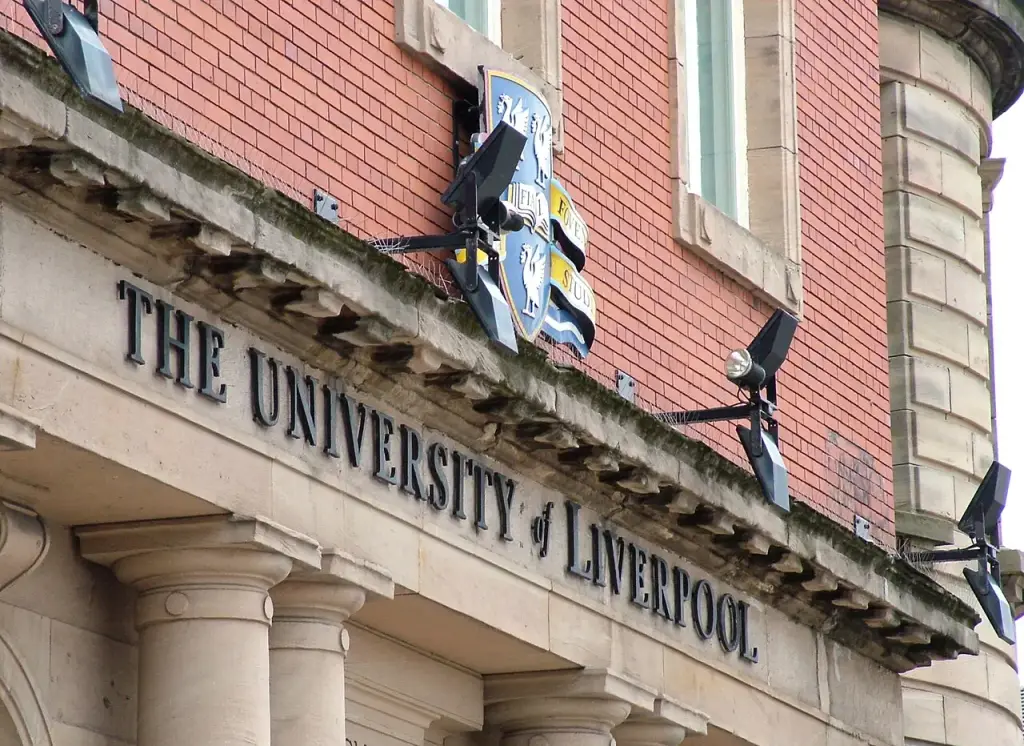
United Kingdom · Liverpool, Merseyside
University of Liverpool
The original "redbrick" university, with medicine, dentistry and veterinary science on offer
Photo: User:Chowells · CC BY-SA 3.0
- QS World Ranking 2027
- #139
- Founded
- 1881
- Students
- 29,000
- Bachelor's degree
- 3 years
- Acceptance rate
- Not published; offers are made course by course
- Typical IB offer
- 26–36 points depending on course (26 Nursing, 5,4,4 HL; 36 Law)
- Typical A-level offer
- BBC–AAA depending on course
- How admission works
- Liverpool states the offer on each course page; Nursing asks 26 IB points (5,4,4 at HL), most arts degrees 30 to 34, sciences 32 to 34 with set Higher Level grades. The Medicine page gives A-levels (AAA with Chemistry) but no IB row. Lower contextual offers of up to two grades are made automatically to applicants who qualify and are not the range shown.
- Language of instruction
- English
Worth knowing
Founded in 1881 as University College Liverpool, it is the university that gave "redbrick" its name, after the red brick of its Victoria Building. Medicine, Dental Surgery and Veterinary Science are all open to international applicants.
How hard is it to get in, and why
Liverpool does not state an offer rate. Its typical A-level offers run from BBC (Nursing) and BBB (Archaeology, Sociology, Classics) to AAA (Law, Architecture, Dental Surgery, Veterinary Science, Medicine), or 26 to 36 IB points, and many degrees ask ABB. Medicine requires the UCAT. Offers are lower than at Manchester, so Liverpool sits at the lower edge of the same level.
What it costs
Tuition
$38k–70k per year
2027/28 entry: £28,000 for Arts and Social Sciences (for example Archaeology, Law, Mathematics from £30,500), £33,000 for most sciences and engineering, £46,200 for Veterinary Science, £52,550 for Dental Surgery and £51,500 for Medicine and Surgery (MBChB); Liverpool lists an international fee on each of these course pages. Liverpool says fees may increase each year. Living costs: Liverpool estimates £900 to £1,350 a month; the 12-month total at the low end, £10,800, is just below the UK government student-visa requirement (£1,203 a month outside London for 9 months, £10,827, for applications from 30 November 2026), so that figure is used as the minimum.
Living costs
$15k–22k per year
Scholarships and financial aid
The Liverpool Excellence Scholarship for undergraduates took £7,500 off first-year fees for international students with AAA or equivalent (not Medicine or Dental Surgery); that information applies to 2026 entry, and Liverpool is reviewing it for 2027 entry. Liverpool names Thailand only in master's awards: the Liverpool Advancement Scholarship and the HRH Princess Sirindhorn University of Liverpool Scholarship. Liverpool lists no Thailand-specific undergraduate scholarship.
How to apply
Apply through UCAS. For most courses the deadline for UK applicants is 13 January 2027 and for international applicants 30 June 2027; for clinical courses (Medicine, Dentistry, Veterinary Science) the international deadline was 15 October 2026 and has passed for 2027 entry. Medicine requires the UCAT. Liverpool also gives a reduced offer, such as ABB with an A in the EPQ for Computer Science, to applicants with an Extended Project.
Official websiteWhat makes it special
- Medicine and Surgery (MBChB), Dental Surgery (BDS) and Veterinary Science (BVSc) are open to international applicants.
- Many degrees can include a year in industry, and some include a year abroad at the partner university in China.
- Entry is published per course in A-level grades and IB points, with Higher Level grades named where they matter.
- A foundation route through University of Liverpool International College is available for students below the entry level.
About studying in United Kingdom
Three-year degrees in England (four in Scotland), and you apply for one subject rather than for a university in general. UCAS allows five choices, only one of which can be Oxford or Cambridge, with a 15 October deadline for those two and for medicine. Oxbridge adds admissions tests and interviews; IB offers at the top range from 38 to 42. International fees run from about £25,000 to £45,000 a year, need-based aid is scarce, and graduates can stay on to work for a limited period under the Graduate visa.
Teaching staff
The dossier on teaching staff for this university is still being written.
The campus in photographs
Photographs come from Wikimedia Commons under free licences; the author and licence are shown on each image.
Reviews
No reviews yet. Visited, applied, or studied here? Be the first.