
Belgium · Leuven, Flanders
KU Leuven
Belgium's oldest university and a top European research university, with a handful of English-taught bachelor's programmes
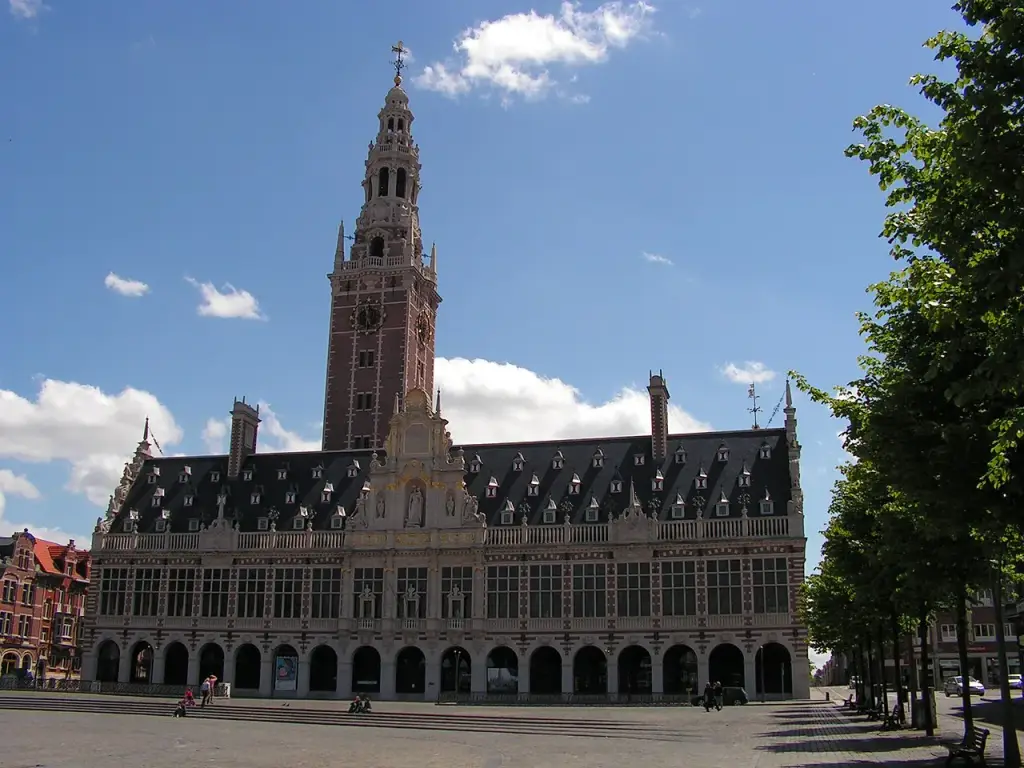
Photo: Wikimedia Commons · Public domain
- QS World Ranking 2027
- #59
- Founded
- 1425
- Students
- 66,000
- Bachelor's degree
- 3 years
- Acceptance rate
- Not published; the English-taught Business Administration programme states it has no limit on places per programme, and medicine and dentistry add a state entrance exam
- Typical IB offer
- IB Diploma Programme is a listed eligible qualification; Business Administration exempts IB from the external maths tests (SAT, ACT, AP, SOWISO), but the faculty's own online maths test is still required (page version 2025-2026)
- Typical A-level offer
- 3 A-levels at grade C or better is the general minimum; programmes may ask for higher grades or set subjects
- How admission works
- Each programme sets its own conditions, and a foreign diploma is assessed through an online application. English-taught programmes ask for a language test, waived for an IB Diploma with at least half of the courses taught in English; Dutch-taught programmes need Dutch at B2, and some at C1. Medicine and dentistry also need the Flemish entrance exam.
- Language of instruction
- Mostly Dutch; a few bachelor's programmes are taught in English, among them Business Administration and Business Engineering (Brussels), Engineering Technology, Philosophy, European Studies, and Theology and Religious Studies (Leuven). Dutch-taught programmes need Dutch at B2 or, for some, C1; medicine is taught in Dutch.
KU Leuven says meeting the minimum criteria makes you eligible to apply but does not guarantee selection. It publishes no IB point total and no profile of admitted students.
Worth knowing
KU Leuven was founded in 1425 and celebrated its 600th anniversary in 2025. It calls itself the oldest university in the Low Countries and the oldest extant Catholic university in the world. It reports 17 738 international students out of 66 306.
How hard is it to get in, and why
Admission is mostly a diploma check plus the programme's own conditions: a recognised secondary diploma such as the IB Diploma, proof of English or Dutch, and for some programmes a mathematics test. Business Administration states that places per programme are not limited and that applications are handled in order of arrival before the deadline. Medicine and dentistry are the exception: they are taught in Dutch and require a pass and favourable ranking in the Flemish government's entrance exam. For most IB students the real filter is language and the early non-EEA deadlines, so the level is closest to Amsterdam and TUM.
What it costs
Tuition
$4k–11k per year
For 2026-27 entry KU Leuven's fee tool lists non-EEA bachelor's fees from €3 093,12 (Theology and Religious Studies) to €9 493,92 (Engineering Technology and Philosophy); Business Administration is €5 613,12, Business Engineering and Laws €5 369 and European Studies €8 500. The tool also shows 2027-28 figures of up to €11 889,40, but the Faculty of Economics and Business says its 2027-28 fees are "currently being revised", so the range uses 2026-27, the latest complete year, and the fee for your entry year should be checked in the tool before applying. A non-EEA student who registers for a Dutch-taught programme with an English-taught equivalent pays the equivalent's increased fee. Living costs: the university says around €1 050–1 400 a month (its summary line says €1 000–1 350) and its blocked account for the student visa requires €1 100 a month, so the range is €1 100 and €1 400 times 12, a calculation.
Living costs
$15k–19k per year
Scholarships and financial aid
KU Leuven's list of scholarships for new international students is mostly for master's programmes: the ASEAN Scholarship, which covers Thailand, is for master's and advanced master's degrees only. A general partial tuition fee waiver is open to bachelor's students, but it depends on residence status in Belgium, such as permanent residence or family reunification, not on merit. All of its conditions concern residence in Belgium.
How to apply
A diploma from outside Flanders needs an online application to the Admissions Office with a €120 fee per application. Applications for 2027-28 opened on 8 October 2026 (European Studies opens on 3 November 2026); for Business Administration (Brussels) and Business Engineering the non-EEA deadline is 1 March 2027, for Philosophy, Biomedical Sciences and Theology also 1 March, for Engineering Technology 15 January and for European Studies 1 April, while Dutch-taught programmes close for non-EEA applicants on 1 February. Test results must be uploaded with the application. The Faculty of Economics and Business says you may apply before you graduate, as long as the degree is obtained before the academic year starts, and a certificate without the original diploma is accepted until 30 November.
Official websiteWhat makes it special
- 66 306 students, 15 faculties, each in the world top 100 of its field according to the university.
- Bachelor's programmes in English are split between Brussels (Business Administration, Business Engineering) and Leuven (Engineering Technology, Philosophy, European Studies, Theology).
- Bachelor of Business Administration is a three-year, 180 ECTS programme in Brussels, fully taught in English and also available in Dutch, with a mandatory online mathematics test from the faculty (IB holders are exempt only from the external SAT, ACT, AP and SOWISO tests).
- Business Engineering is a joint programme with UCLouvain Saint-Louis Bruxelles: students attend courses and take exams at both institutions and get a joint degree.
- Non-EEA graduates can apply for a residence permit for a search year after their studies.
About studying in Belgium
A bachelor's degree takes three years (180 ECTS), as at KU Leuven, which publishes both Dutch-taught and English-taught programmes; most bachelor's programmes are taught in the local language, with a few English-taught options such as business administration in Brussels, so the language of each programme is the first thing to check. Applications go to the university directly online with a EUR 120 fee, and for Dutch-taught programmes the deadline for non-EEA applicants is 1 February, while English-taught programmes have their own windows. Tuition is calculated per applicant by a published fee tool, with a different rate for non-EEA students and a higher fee for English-taught equivalents of Dutch programmes; no single figure applies. The language and the early deadline need checking first.
Teaching staff
The dossier on teaching staff for this university is still being written.
The campus in photographs
Photographs come from Wikimedia Commons under free licences; the author and licence are shown on each image.
Reviews
No reviews yet. Visited, applied, or studied here? Be the first.