
Sweden · Stockholm
KTH Royal Institute of Technology
Sweden's largest technical university, in Stockholm
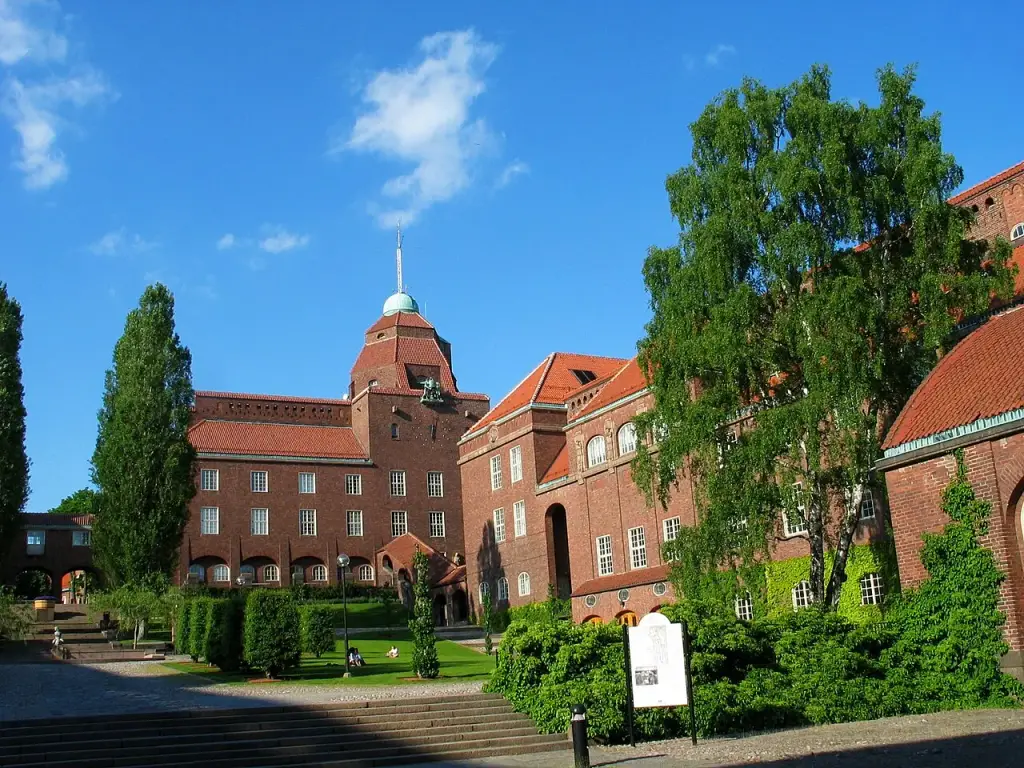
Photo: Jonas Bergsten · Public domain
- QS World Ranking 2027
- #82
- Founded
- 1827
- Students
- 15,000
- Bachelor's degree
- 3 years
- Acceptance rate
- 10% of eligible applicants admitted to the English-taught ICT bachelor's (2024); no university-wide rate published
- Typical IB offer
- Diploma with 24 points; passing grades in English, Maths AA SL or AI HL, and Physics SL/HL
- Typical A-level offer
- A/AS-level Maths (grade E or above) and A/AS-level Physics; GCSE English grade C
- How admission works
- Applications go through Universityadmissions.se. English 6 can be shown with IELTS Academic 6.5 (no section below 5.5), or TOEFL iBT 90 with 20 in writing for results up to 20 January 2026, or 4.5 on the 1-6 scale (no section below 4) for results from 21 January 2026. Predicted grades are not accepted and conditional admission in the final school year is not possible.
- Language of instruction
- One bachelor's programme is taught in English (Information and Communication Technology, 180 credits); no Swedish is required for it. English 6 is required.
These are KTH's eligibility minimums, not what admitted students hold; admission is competitive. KTH publishes no minimum merit score.
Worth knowing
KTH is the lead partner in five EIT innovation communities: EIT InnoEnergy, EIT Digital, EIT Health, EIT Raw Materials and EIT Urban Mobility. It has primary responsibility for five national strategic research areas, including IT and mobile communication.
How hard is it to get in, and why
KTH offers one bachelor's programme in English, Information and Communication Technology, and says admission is highly competitive, with far fewer places than qualified applicants: 10% of eligible applicants were admitted in 2024. Eligibility requires advanced Mathematics and Physics, and KTH offers no entrance tests or bridging courses.
What it costs
Tuition
$15k per year
KTH's fee regulation for studies starting in 2027/28 sets SEK 151 000 per academic year for first-cycle programmes, and its fee page gives SEK 453 000 as the full tuition for the three-year ICT bachelor's (non-EU/EEA/Swiss citizens). The fee is charged in advance each semester; the SEK 900 application fee is paid to University Admissions. Living: the lower figure is the Migration Agency requirement of SEK 10 656 a month , the latest amount listed, for applications made in 2026 (×12 = SEK 127 872, a calculation); the upper is the highest of three student examples on KTH's page, SEK 13 000 a month (×12 = SEK 156 000), which KTH says is not an official budget.
Living costs
$13k–16k per year
Scholarships and financial aid
KTH offers no scholarships for its bachelor's programme. Students need to cover tuition and show the Migration Agency's maintenance funds themselves.
How to apply
Apply on Universityadmissions.se in round 1: it opens 16 October 2026 and closes 15 January 2027, with documents and the application fee due 1 February and results on 8 April 2027. Students in the final year of upper secondary school cannot submit a complete application in round 1, and KTH accepts neither predicted grades nor conditional admission. The programme starts in August.
Official websiteWhat makes it special
- 15 460 full-time students, with 1 513 active doctoral students.
- The English-taught ICT bachelor's has a large share of elective courses, for example in AI and machine learning.
- The ICT bachelor's is taught entirely in English and combines electronics, software and communications technology with economics and sustainable development.
- Teaching happens on KTH's main campus in Stockholm; KTH Housing studios cost SEK 8 200 a month.
About studying in Sweden
Bachelor's degrees take three years (180 credits). Applications go through the national portal Universityadmissions.se, and its first round, which closes in mid-January, is the one recommended for anyone who needs a residence permit. English-taught bachelor's programmes are few: KTH lists only one, in information and communication technology, while Lund offers some, such as International Business. Students from outside the EU/EEA and Switzerland pay tuition: Lund's International Business costs SEK 390,000 for the full three years, paid in instalments before each semester. The honest caveat is the narrow choice of English-taught bachelor's places combined with a high price.
Teaching staff
The dossier on teaching staff for this university is still being written.
The campus in photographs
Photographs come from Wikimedia Commons under free licences; the author and licence are shown on each image.
Reviews
No reviews yet. Visited, applied, or studied here? Be the first.