Germany · Karlsruhe, Baden-Württemberg
Karlsruhe Institute of Technology (KIT)
A technical university merged with a national research centre, with an English-taught mechanical engineering bachelor's
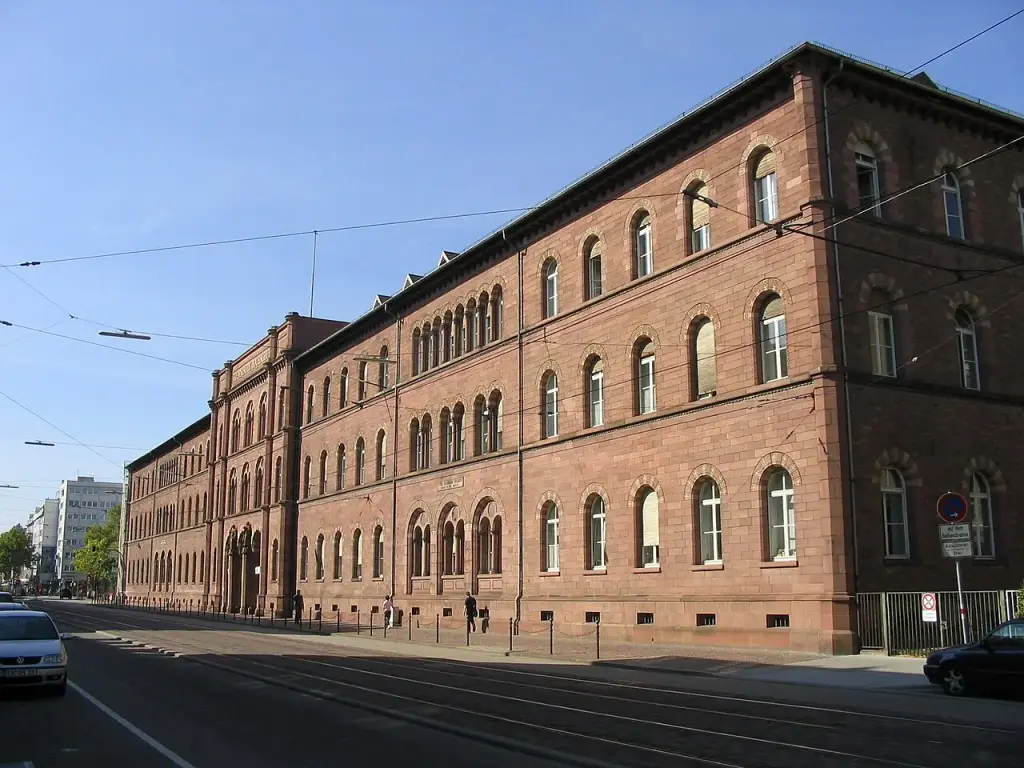
Photo: AlterVista at German Wikipedia · CC BY-SA 3.0
- QS World Ranking 2027
- #110
- Founded
- 1825
- Students
- 23,000
- Bachelor's degree
- 3 years
- Acceptance rate
- Not published; subjects with numerus clausus rank applicants, the others admit those who meet the requirements
- Typical IB offer
- KMK Diploma (6 subjects, each 4+); English-taught Mech. Eng.: Maths HL, Physics HL or SL
- How admission works
- The KMK rules also require at least one Higher Level subject among language, maths or science, and allow one grade 3 if offset by a 5 and 24 points elsewhere. If the certificate is not recognised for direct entry, the route is a Studienkolleg and its Feststellungsprüfung. B.Sc. Mechanical Engineering (International) publishes its own IB condition (Mathematics HL unless the school is on a list with special arrangements; Physics HL or SL) and asks for SAT 1,200, ACT 24 or TestAS percentile 75, and a motivation letter.
- Language of instruction
- German for most bachelor's programmes (German proof B1 to apply, DSH-2 or an equivalent at enrolment). The B.Sc. Mechanical Engineering (International) is taught entirely in English and asks for IELTS 6.5 or an equivalent TOEFL score unless English was the language of instruction.
KIT publishes no IB points cut-off and no A-level grades; the IB conditions are the national KMK recognition rules, and the SAT, ACT or TestAS minimum applies only to the English-taught programme. KIT states that a school certificate equal to the Abitur, such as A-levels, is needed for that programme but does not list A-level subjects.
Worth knowing
KIT traces its roots to the Polytechnic School founded on 7 October 1825 and became KIT in 2009 by merging the University of Karlsruhe with the Karlsruhe Research Center. In winter semester 2025/26, 5,878 of its 23,083 students are international, about 25.5 percent.
How hard is it to get in, and why
KIT states no acceptance rate. In subjects with a numerus clausus, applications go through a ranking and a registration on hochschulstart.de; chemistry adds selection interviews. German-taught programmes need DSH-2 or an equivalent at enrolment. The English-taught Mechanical Engineering (International) adds a motivation letter and a SAT, ACT or TestAS score.
What it costs
Tuition
$4k–30k per year
Baden-Württemberg charges non-EU students €1,500 per semester, and KIT's semester contributions come to €184 (€80 administration, €92 Studierendenwerk, €12 student body), so two semesters cost €3,368 a year. The top of the range adds the Carl Benz School College Program at €11,780 per semester in semesters 1–4 (€23,560 a year, housing included), for €26,928 in those years; the school's pages list this fee in addition to the KIT fees and do not say whether it can be waived. Graduates of a German school (including abroad) are exempt from the €1,500. KIT's own estimate of €800–900 a month is below the German student-visa minimum of €992 a month, so living costs are set at the minimum of €11,904 a year.
Living costs
$13k per year
Scholarships and financial aid
KIT's student guide lists the thirteen national scholarship foundations and the Deutschlandstipendium but does not say which of them are open to non-EU applicants. The Carl Benz School College Program and its fees are separate from any scholarship. Students from the EU, doctoral students and Baden-Württemberg Stiftung scholars are exempt from the €1,500 fee.
How to apply
Non-EU applicants apply through the International Students Office. The bachelor's portal opens on 15 May and closes on 15 July, with no extended deadline for non-EU applicants; subjects with a numerus clausus also need a hochschulstart.de registration. Entry is for winter semester only. Admission decisions come within four weeks of the deadline. For Mechanical Engineering (International), applications run from December to 30 April; the portal for the 2027/28 intake reopens in December 2026.
Official websiteWhat makes it special
- Engineering sciences account for 14,238 of 23,083 students in winter semester 2025/26.
- B.Sc. Mechanical Engineering (International): six semesters, 180 ECTS, taught in English, starts in October; classes are capped at 60 students.
- An eight-week Pre-Semester in maths, physics, chemistry and English costs €4,500 and is required for applicants with indirect admission.
- KIT offers 45 undergraduate bachelor's programmes.
- The College Program of the Carl Benz School, priced on top of the KIT fees, includes on-campus housing in the first four semesters.
About studying in Germany
Public universities are close to free for most students; Bavaria, where TU Munich sits, has introduced a fee for students from outside the EU, still a fraction of Anglo-American prices. Most bachelor's programmes are taught in German (level C1 is expected), with a growing number in English. Admission for an IB Diploma is largely formal, and the real test is keeping up with a demanding, self-directed course.
Teaching staff
The dossier on teaching staff for this university is still being written.
The campus in photographs
Photographs come from Wikimedia Commons under free licences; the author and licence are shown on each image.
Reviews
No reviews yet. Visited, applied, or studied here? Be the first.