
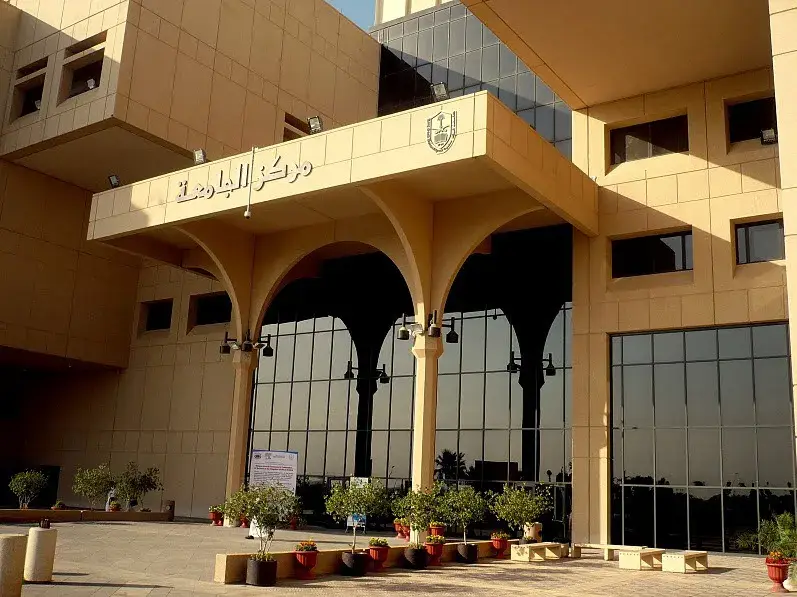
Saudi Arabia · Riyadh
King Saud University
A large public university in Riyadh with its own university medical city
Photo: Abrnkak · Public domain
- QS World Ranking 2027
- #107
- Founded
- 1957
- Students
- 86,000
- Bachelor's degree
- 4 years
- Acceptance rate
- Not published; external scholarship seats are limited and allocated by nationality
- How admission works
- Non-residents of Saudi Arabia apply through Study in Saudi for an external scholarship (SAT of at least 1010, age 17-25, diploma within the last five years, home-country government approval where required, no other Saudi scholarship) or, in health sciences, for a fee-based place (SAT of at least 1200 for Medicine and Surgery, which also needs a diploma from the last two years). Non-Arabic-speaking scholarship applicants are first placed in the Arabic Language Proficiency Diploma, then move on to the bachelor's.
- Language of instruction
- Arabic and English, depending on the programme; Arabic proficiency year for non-Arabic-speaking scholarship students
The university publishes no IB or A-level requirement; KSU asks for a high-school diploma or equivalent from the applicant's home country that is recognised for the intended programme. Many scholarship programmes, including all engineering ones, are listed as male-only.
Worth knowing
KSU says its university medical city was ranked first in the SCImago health-institutions ranking for oncology and cardiology, and that KSU published 23% of the academic research in Saudi Arabia in 2025.
How hard is it to get in, and why
The external scholarship route needs a high-school diploma recognised for the programme, a valid SAT score of at least 1010, age 17-25 and a diploma earned within the last five years. KSU states that acceptance is a competitive process and depends on the number of seats available by nationality. Medicine and Dentistry add an interview, Architecture a written test. Rated 2, closest to Amsterdam: a formal minimum plus a quota, with no published selectivity figure.
What it costs
Tuition
$0–21k per year
External scholarship places carry a tuition exemption, housing, discounted meals, flight tickets and a monthly stipend, so tuition is 0 on that route. The fee-based health-sciences programmes for non-residents are listed on Study in Saudi as Paid Study, where the student bears all tuition and living costs, at SAR 68,387 to SAR 78,752 a year depending on the programme; Study in Saudi does not name the intake. It publishes no price for the paid Medicine and Dentistry places, so SAR 78,752 is the highest published price, not a ceiling. KSU publishes no living-cost estimate or housing rate for international applicants, so living is not disclosed; ask the university.
Living costs
not disclosed
Scholarships and financial aid
KSU's external scholarship for non-resident international students is fully funded: tuition exemption, housing, discounted meals, a flight ticket on acceptance and at the end of each academic year, a monthly stipend (SAR 1,000 for science majors and SAR 850 for humanities and social sciences, per KSU's International Students Department; a stipend, not a cost-of-living estimate), a two-month arrival allowance, healthcare and a three-month graduation allowance. Seats are limited and allocated by nationality. The list of benefits comes from the 1446 AH cycle, so confirm current terms on Study in Saudi.
How to apply
Non-residents apply through the Ministry of Education's Study in Saudi platform. The scholarship track needs an SAT score of 1010 or more, attested certificates, a medical examination and sometimes a recommendation; Medicine and Dentistry applicants are interviewed, and Architecture applicants sit a written test. Acceptance depends on a competitive process and seat numbers by nationality, followed by final approval from the Ministry of Education and visa issue. KSU has not published application dates for the 2027 intake; its previous published window ran 18 August to 18 September 2024.
Official websiteWhat makes it special
- Scholarship programmes cover engineering, computer science, architecture, sciences and business, with some open to women and some to men only.
- Study in Saudi lists AACSB (business), ABET (engineering) and ACPE (pharmacy) accreditation.
- Fee-based bachelor's places for non-residents are limited to health-sciences programmes such as pharmacy, nursing and physical therapy.
- Scholarship students are housed in university housing and offered discounted meals.
About studying in Saudi Arabia
King Fahd University of Petroleum and Minerals (KFUPM) teaches all courses in English; its engineering bachelor's takes four years plus one year in an orientation programme. International applicants apply directly through its admission website, and the SAT track asks for a score of 1350 or more, a natural-sciences background and a maths assessment. For students living outside Saudi Arabia, KFUPM states that tuition is waived under a full scholarship that also covers housing and a monthly stipend, so the real hurdle is winning a scholarship place rather than paying fees. King Saud University admits non-resident foreigners through external scholarships applied for on the national Study in Saudi portal, with an age limit of 25; check the language of instruction at King Saud and King Abdulaziz before assuming English. Places are scholarship-led, and the conditions may change.
Teaching staff
The dossier on teaching staff for this university is still being written.
The campus in photographs
Photographs come from Wikimedia Commons under free licences; the author and licence are shown on each image.
Reviews
No reviews yet. Visited, applied, or studied here? Be the first.