
South Korea · Daejeon
Korea Advanced Institute of Science and Technology
Korea's science and engineering university, with a full scholarship for international undergraduates
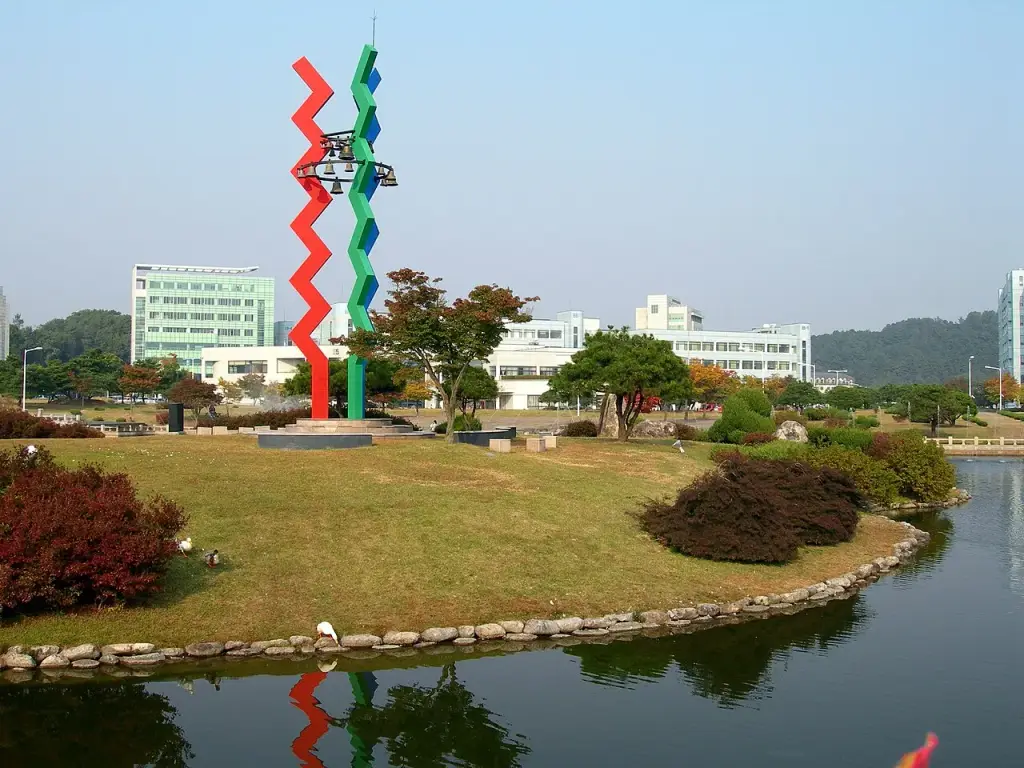
Photo: Original uploader was Dr.aleks at en.wikipedia · CC BY 2.5
- QS World Ranking 2027
- #65
- Founded
- 1971
- Students
- 12,000
- Bachelor's degree
- 4 years
- Acceptance rate
- Not published; the university does not disclose its evaluation criteria or admit rates for international applicants
- Typical IB offer
- IB accepted as the required standardized test; predicted IB gives conditional admission; no points cut-off published
- Typical A-level offer
- A-level accepted as the required standardized test; predicted grades give conditional admission; no cut-off published
- How admission works
- Apply directly on KAIST's own portal. At least one official standardized test score (SAT, ACT, AP, IB, A-level or a national leaving exam) is required, and strong maths and science results are encouraged. An English test is also required, with recommended scores of TOEFL iBT 4.5 on the scale used from 21 January 2026 (83 on the old scale) or IELTS 6.5; nationals of listed English-speaking countries and graduates of English-medium high schools can be exempt.
- Language of instruction
- English-medium instruction for international undergraduates (most courses), with optional Korean classes
KAIST publishes no IB or A-level points threshold, and the English scores are labelled as recommended, not minimum. Neither parent may be a Korean citizen.
Worth knowing
First-year students do not declare a major: they choose one at the end of the second semester, and there is no quota per department. KAIST also says it ranked first in Korea in the industry-income indicator of the THE World University Rankings 2026.
How hard is it to get in, and why
KAIST does not publish an admit rate and says the details of its evaluation will not be disclosed. It reads the documents holistically, with the level of maths and science coursework weighted most, and may hold an online interview only for some applicants. One official standardized test score is required, and every international student gets a full scholarship, which raises the stakes. By mechanism, the closest anchor is NUS: a document-led, science-heavy selection with no formal cut-off.
What it costs
Tuition
$5k per year
KAIST's cost-of-attendance table lists tuition of KRW 3,433,000 per semester and KRW 6,866,000 for the two semesters shown. All international undergraduates receive a scholarship covering the full tuition for 4 years, plus a stipend of KRW 350,000 a month, so the tuition is not paid in practice. The living range is a calculation from the same table, covering housing, food, books and national health insurance (KRW 8,019,680 for the year) and the low optional costs for student insurance and telecoms on top (KRW 8,472,680); tuition is not included. The housing line is based on a shared room in one residence hall.
Living costs
$6k per year
Scholarships and financial aid
Every admitted international undergraduate is entitled to the KAIST Scholarship: tuition exemption for 8 semesters, KRW 350,000 a month in living expenses and national health insurance. There is no separate application; applicants tick the box in the financial-resources section of the admission form. Students must keep a GPA above 2.7 out of 4.3 after the first year.
How to apply
Apply on KAIST's own online portal and pay an application fee of USD 80. For 2027 entry, the Early track (spring or fall start) closed on 22 October 2026. The Regular track (fall 2027 start) runs from 10 November 2026 to 14 January 2027, 6:00 PM KST, with results on 25 March 2027. The application needs transcripts, a passport copy, at least one standardized test score, an English test score, and essays; recommendation letters are optional (up to two) from the 2027 cycle. An online interview is held only if KAIST considers it necessary, and the Regular-track interview date is 3 March 2027.
Official websiteWhat makes it special
- Founded in 1971; the main campus is in Daejeon, and the university reports about 12,000 students at all levels, about 4,000 of them undergraduates.
- Undergraduate fields run from physics, chemistry and life sciences to computing, AI, mechanical, electrical and nuclear engineering, plus business and technology management.
- KAIST cites QS subject rankings 2025 placing it 24th in Engineering and Technology and first in Korea.
- The Undergraduate Research Participation (URP) programme gives undergraduates hands-on research.
- A Global Talent Visa Center of the Ministry of Justice is on the main campus.
About studying in South Korea
Four-year degrees, with applications made to each university directly. Study in Korea says a regular programme generally expects TOPIK level 3 on admission and level 4 to graduate, though an English test can be accepted instead for admission, and some universities run English-taught tracks or faculties; roughly 30% of courses at internationalised universities are in English, mostly beyond the first years. The guidebook puts bachelor's tuition at roughly KRW 5 to 7 million per semester, but it varies by university, so check the one you want. The practical catch is Korean outside the English tracks and the amount of coursework taught in it.
Teaching staff
The dossier on teaching staff for this university is still being written.
The campus in photographs
Photographs come from Wikimedia Commons under free licences; the author and licence are shown on each image.
Reviews
No reviews yet. Visited, applied, or studied here? Be the first.