Germany · Berlin
Humboldt University of Berlin
Berlin's classic research university in the humanities and social sciences, with no tuition and all bachelor's teaching in German
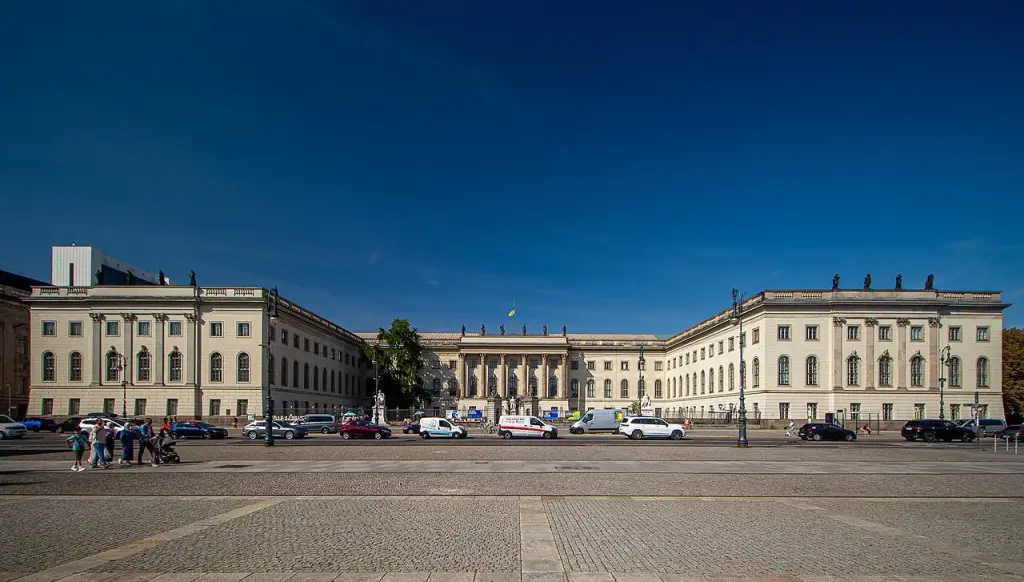
Photo: VitVit · CC BY-SA 4.0
- QS World Ranking 2027
- #140
- Founded
- 1810
- Students
- 36,000
- Bachelor's degree
- 3 years
- Acceptance rate
- Not published; restricted subjects fill a 5% quota for non-EU applicants by school-grade average
- Typical IB offer
- Full Diploma per KMK: 6 subjects incl. 2 languages, science, maths, social science; each grade 4+
- How admission works
- HU has applications from foreign certificates pre-checked by uni-assist; the recognition decision is made there. The KMK rules also require at least one Higher Level subject among language, maths or science. If the certificate does not give direct entry, the route is a joint Studienkolleg with FU Berlin (German B2 required, aptitude test in August) and its Feststellungsprüfung.
- Language of instruction
- German: all bachelor's programmes are taught exclusively in German. C1 is required with the application (for example Goethe C1, telc C1 or DSH-1, or TestDaF 3 in every part); DSH is then taken at HU before enrolment, unless TestDaF 4 in every part or an equivalent is shown.
HU states no IB points cut-off and publishes no A-level conditions; it refers to the anabin database and the uni-assist check. The IB conditions above are the national KMK recognition rules.
Worth knowing
HU was founded in 1810 and has about 36,000 students. In 2024 international students made up 18 percent of them, but only 9 percent of bachelor's students.
How hard is it to get in, and why
HU publishes no acceptance rate. In subjects with a numerus clausus, non-EU applicants compete for a fixed quota of 5 percent of first-semester places, awarded solely by the average grade of the school certificate. German at C1 is required with the application, and every bachelor's programme is taught in German. Subjects without a numerus clausus admit applicants who meet the formal requirements.
What it costs
Tuition
$800 per year
HU's pages list no tuition for bachelor's students, only a semester contribution, which the university lists at €355.80 for summer semester 2026 (€50 fees, €12 student body, €85 Studierendenwerk, €208.80 Germany semester ticket). Two semesters at that rate come to about €712 a year. HU does not state its own cost-of-living estimate, so living costs are set at the German student-visa minimum of €992 a month (€11,904 a year).
Living costs
$13k per year
Scholarships and financial aid
The Deutschlandstipendium pays €300 a month for at least two semesters to students of all nationalities, including first-year applicants. The 2027/28 round takes applications from 9 November to 6 December 2026, with funding from 1 April 2027, and about 90 scholarships are expected, 57 of them open to every programme. HU lists no scholarship of its own for non-EU bachelor's applicants.
How to apply
Applicants with a foreign certificate apply through uni-assist, which checks the documents. The deadline is a cut-off: 1 June to 15 July for winter semester and 1 December to 15 January for summer semester, for all international applicants, EU included; HU states these as its standing dates, and 2027 dates are not yet published separately. Documents include the certificate with subject and grade list, a German C1 certificate and a CV. Restricted subjects are decided in early or mid-August; non-EU applicants compete for the 5 percent quota.
Official websiteWhat makes it special
- A monobachelor is 180 credits over six semesters; a combination bachelor pairs a 120-credit core subject with a 60-credit second subject, also six semesters.
- 63 bachelor's and other undergraduate programmes are on offer.
- HU runs no preparatory German courses; the joint Studienkolleg with FU Berlin takes applicants whose certificate gives no direct entry.
- Non-EU applicants to restricted subjects share a quota of 5 percent of places, awarded by school-grade average.
- The Germany semester ticket is mandatory and is included in the semester contribution.
About studying in Germany
Public universities are close to free for most students; Bavaria, where TU Munich sits, has introduced a fee for students from outside the EU, still a fraction of Anglo-American prices. Most bachelor's programmes are taught in German (level C1 is expected), with a growing number in English. Admission for an IB Diploma is largely formal, and the real test is keeping up with a demanding, self-directed course.
Teaching staff
The dossier on teaching staff for this university is still being written.
The campus in photographs
Photographs come from Wikimedia Commons under free licences; the author and licence are shown on each image.
Reviews
No reviews yet. Visited, applied, or studied here? Be the first.