Japan · Sapporo, Hokkaido
Hokkaido University
Northern Japan's flagship national university, with admission mainly in Japanese and one English-taught Japanese Studies degree
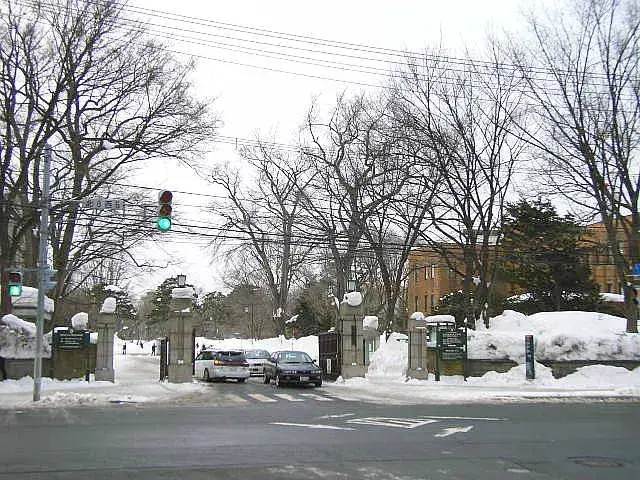
Photo: Wikimedia Commons · Public domain
- QS World Ranking 2027
- #179
- Founded
- 1876
- Students
- 18,000
- Bachelor's degree
- 4 years
- Acceptance rate
- Not published; the foreign-applicant route lists 'a few' places per school within the general intake, and the English-taught Modern Japanese Studies Program lists about 12 places in the first call and about 8 in the second (October 2027 entry)
- Typical IB offer
- IB Diploma accepted as a basis to apply (MJSP and the Japanese-taught route); no points cut-off published
- Typical A-level offer
- GCE and International A-level accepted as a basis to apply; no grade cut-off published
- How admission works
- MJSP, October 2027 entry (Intensive Japanese Course first, bachelor's in April 2028): first call online registration 27 October to 4 November 2026 and recommendation letter by 20 November 2026, second call 2-9 February 2027; English proof is four years of secondary education in English or TOEFL iBT 79 (120 scale) / IELTS 6.5; selection by documents and online interview. The Japanese-taught route for April 2027 entry (EJU in Japanese and sciences, English test, essay and interview) closed on 18 September 2026; its second stage is on 15 November 2026.
- Language of instruction
- Japanese for most bachelor's programmes; the Modern Japanese Studies Program is taught with English-language entry requirements and begins with a one-semester Intensive Japanese Course
The university publishes no IB or A-level grade requirement for either route. For MJSP it states that applicants with national standardized exam results are encouraged to have taken them.
Worth knowing
The university was established in 1876 as Sapporo Agricultural College. Its facts page lists 1,998 international students from 96 countries and regions among 18,480 students.
How hard is it to get in, and why
The university publishes no admission rate for foreign applicants. The English-taught Modern Japanese Studies Program (MJSP) is chosen by a review of transcripts, personal statements and an online interview, with an English-language requirement and about 20 places a year. The Japanese-taught route needs EJU scores above school-specific minimums, then a second stage with an essay and interview, or, in some Science departments, an aptitude test. The closest anchors are HKUST and Melbourne: a small quota with a published language bar and an interview, but no published acceptance rate.
What it costs
Tuition
$3k per year
The 2027 application guidelines give tuition of ¥267,900 for the first semester of 2027 (¥535,800 for the whole year) and an enrollment fee of ¥282,000 (estimated); the fee page adds an examination fee of ¥17,000 and says tuition is paid in May and November. The MJSP application fee is ¥5,000. The living figure is a calculation: the School of Engineering's page for its English-taught programme says the monthly cost for a single student is about ¥100,000, multiplied by 12. The university also has a system that can exempt part or all of entrance and tuition fees for self-supported students who meet its conditions.
Living costs
$8k per year
Scholarships and financial aid
The international-student handbook lists the Japanese government (MEXT) scholarship stipend at ¥117,000 a month for undergraduates and Japanese Studies students, with ¥3,000 a month added from November to March. The application guidelines say other government and organisation scholarships can be applied for after admission and that the number is limited. Self-supported students can apply to the faculty office for a full or partial waiver of entrance and tuition fees.
How to apply
MJSP applicants register online and upload documents: transcripts, an English proficiency result and personal statements, with a recommendation letter sent separately. For the October 2027 start the first call closes on 4 November 2026, interviews are online from 5 to 14 January 2027, and results are expected on 12 February 2027; the second call runs 2-9 February 2027, with results expected on 13 May 2027. The Japanese-taught route for April 2027 entry (EJU, English test, essay or aptitude test, interview) took applications from 14 to 18 September 2026 and is closed.
Official websiteWhat makes it special
- Modern Japanese Studies Program: a four-year degree in Japanese Studies (4.5 years with the Intensive Japanese Course), 46 students in total.
- Applicants with intermediate Japanese can apply for April bachelor's entry; others enter in October through the Intensive Japanese Course; N2-level holders can apply to skip that course.
- Twelve undergraduate schools; Engineering is the largest with 2,329 students.
- Six dormitories and international houses; around half of all international students live on campus.
About studying in Japan
Four-year degrees, taught mostly in Japanese. Admission usually runs through each university, and many ask for the EJU exam, which can be taken in English or Japanese except for its Japanese-language test. English-taught bachelor's options are few: Kyoto's international undergraduate programme (iUP) uses English and Japanese, and the University of Tokyo's all-English Global Science Course is a transfer programme entering in year 3, so it does not suit school-leavers. National universities charge a standard ¥535,800 a year plus an entrance fee of about ¥282,000, but the ministry allows up to 1.2 times the standard and Tohoku will raise international tuition to ¥900,000 from 2027, so fees may rise. Private universities cost more, and the language is the real barrier outside a few programmes.
Teaching staff
The dossier on teaching staff for this university is still being written.
The campus in photographs
Photographs come from Wikimedia Commons under free licences; the author and licence are shown on each image.
Reviews
No reviews yet. Visited, applied, or studied here? Be the first.