Netherlands · Groningen, Groningen
University of Groningen
Large Dutch research university with 34 English-taught bachelor's programmes and a quarter of students from abroad
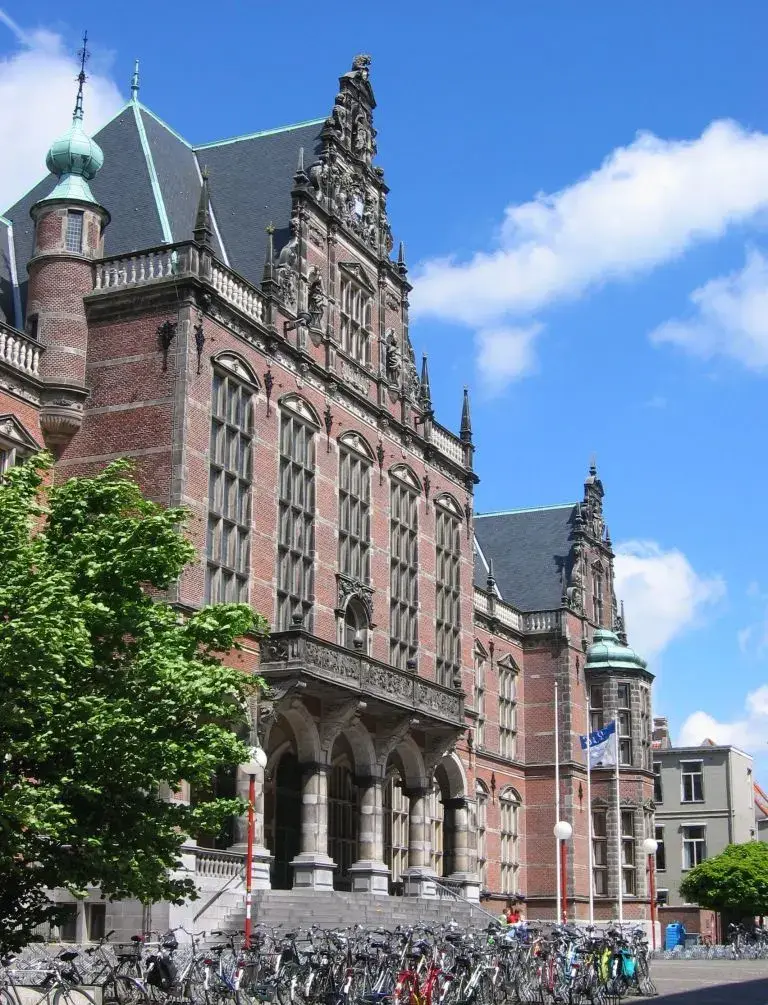
Photo: Fruggo · CC BY 1.0
- QS World Ranking 2027
- #157
- Founded
- 1614
- Students
- 33,000
- Bachelor's degree
- 3 years
- Acceptance rate
- Not published; two English-taught programmes (International Business, Psychology) select applicants for limited places, the rest admit applicants who meet the entry requirements
- Typical IB offer
- IB Diploma with programme subjects, e.g. Maths AA HL for Computing Science; Physics also needs Physics HL
- Typical A-level offer
- 3 academic A-levels at A*–C; Maths, Physics or Chemistry A-level where the programme requires them
- How admission works
- Each programme sets its own subject conditions (International and European Law and Human Geography and Planning set none). English proof depends on the faculty (IELTS 6.0 for the Faculty of Science and Engineering and Economics and Business, 7.0 for Law); an IB Diploma taught in English or 3 A-levels at A–C exempts you from the test. Apply through Studielink and the Progress Portal.
- Language of instruction
- English for 34 of its bachelor's programmes, among them Psychology, International Business, Computing Science, Artificial Intelligence, Physics and International and European Law; Medicine, Dentistry, Pharmacy and some others are taught in Dutch. English proficiency levels range from IELTS 6.0 to 7.0 depending on the faculty.
The university publishes no IB point total and no A-level grade bar beyond A*–C; it says no rights can be derived from the requirements listed.
Worth knowing
The University of Groningen was founded in 1614 and reports four Nobel Prize winners. Its key figures put 26% of its students (8 500 people) at international students from more than 120 nationalities, and it says Groningen is the youngest city in the Netherlands.
How hard is it to get in, and why
International Business and Psychology are numerus fixus programmes with limited places. The selection uses an early admission, an entry test or assignment, the CV and a motivation letter; applications close on 15 January and offers come on 15 April. Other programmes assess the diploma level and subject requirements, and first-year students need at least 45 of 60 ECTS to continue. The university does not publish an acceptance rate.
What it costs
Tuition
$16k–22k per year
University tuition fee II for non-EU/EEA students in 2027-28: €14 400 for most English-taught programmes (Arts, Economics and Business, Behavioural and Social Sciences, Law, Spatial Sciences, Philosophy, Religion, Culture and Society, Data Science and Society), €17 200 for Global Politics & Sustainability, €17 700 for University College Groningen and €19 800 for Science and Engineering. Dutch-taught Medicine and Dentistry cost €32 000 and are not in the range. EU/EEA students pay €2 771. Living costs: the university estimates €13 000–16 000 a year excluding tuition; the lower bound is raised to the Dutch immigration service (IND) requirement of 12 months at its 2026 study norm of €1 130,77, about €13 600 (a calculation).
Living costs
$15k–18k per year
Scholarships and financial aid
The university's Grantfinder lists scholarships for international students at bachelor's, master's and PhD level, some from the university and others from outside funders such as the Dutch government and the EU. Eligibility and amounts differ per grant, and there is no standard bachelor's award.
How to apply
Apply in Studielink, then upload documents in the Progress Portal; the Admissions Office checks that your diploma is at Dutch pre-university level and that you took the programme's subjects. Most programmes close on 1 May; numerus fixus programmes (International Business, Psychology) close on 15 January 2027, require an entry test or assignment, a CV and a motivation letter, and send offers on 15 April. Applicants who need a visa must submit an English test result by 1 July.
Official websiteWhat makes it special
- About 32 500 students, 11 faculties (one in Leeuwarden) and 45 bachelor's programmes, most taught in English.
- Two campuses: Groningen and Leeuwarden, where Campus Fryslân teaches Global Politics & Sustainability and Data Science & Society.
- University College Groningen offers Liberal Arts and Sciences with a September and a February intake.
- Binding study advice: students who earn fewer than 45 of 60 ECTS in the first year must stop the degree.
- Early Bird: complete applications sent between 1 October and 28 February to many faculties get a decision within 15 working days.
About studying in Netherlands
Three-year bachelor's degrees, many of them taught entirely in English, with applications through the national Studielink portal. Popular programmes use numerus fixus selection with a 15 January deadline; the rest close on 1 May. Fees for non-EU students range from roughly €10,000 to €20,000 a year. Every university applies a binding study advice: earn most of the first-year credits or leave the programme.
Teaching staff
The dossier on teaching staff for this university is still being written.
The campus in photographs
Photographs come from Wikimedia Commons under free licences; the author and licence are shown on each image.
Reviews
No reviews yet. Visited, applied, or studied here? Be the first.