
United Kingdom · Exeter, Devon
University of Exeter
A Russell Group university in the South West, with a medical school and a second campus in Cornwall
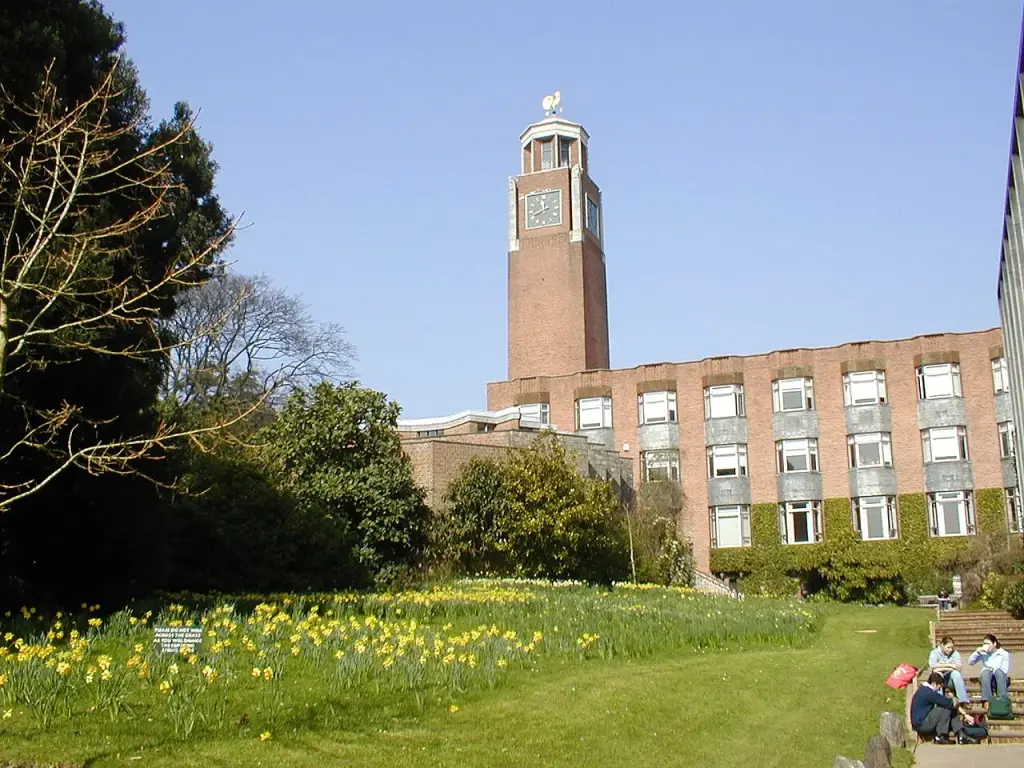
Photo: Myself, Benjamin Evans · Public domain
- QS World Ranking 2027
- #136
- Founded
- 1955
- Students
- 30,000
- Bachelor's degree
- 3 years
- Acceptance rate
- Not published; offers are made course by course
- Typical IB offer
- 30–38 points depending on course (555 to 766 at HL)
- Typical A-level offer
- BBB–A*AA depending on course
- How admission works
- Exeter publishes the IB equivalent of each A-level grade on its international qualifications page (for example AAB = 34 points or 665 at HL, A*AA = 38 or 766). The lowest end is Archaeology and Anthropology (ABB to BBB, 32 to 30 points); the highest are Economics and BMBS Medicine (A*AA, 38 points). Contextual offers two grades lower are made to applicants meeting widening-participation criteria and are not the range shown.
- Language of instruction
- English
Worth knowing
Exeter teaches on three campuses: Streatham, the main campus in Exeter; St Luke's, home to Medicine, Medical Sciences, Education and Sport and Health Sciences; and Penryn in Cornwall. It received its royal charter as a university in 1955.
How hard is it to get in, and why
Exeter does not state an offer rate. Its typical offers run from BBB (Archaeology and Anthropology, lowest end of the range) to A*AA (Economics and Medicine), or 30 to 38 IB points, and most degrees sit at AAB to AAA. Medicine adds the UCAT or GAMSAT, an interview and a 15 October UCAS deadline. Exeter warns that meeting the typical offer does not guarantee a place, which puts it at the lower end of the level of Manchester.
What it costs
Tuition
$34k–66k per year
2027 entry: £25,700 for arts, humanities, social sciences, law and business subjects, £31,500 for Computer Science, Engineering, Mathematics, Physics and Geography, £32,150 for Biosciences and Psychology, and £49,300 for BMBS Medicine, which Exeter lists with an international fee and is open to international applicants. Exeter's policy is to raise fees in each year of study, expected to follow inflation. Living costs: Exeter estimates £1,300 to £2,000 a month, which over 12 months is £15,600 to £24,000; both are above the UK government student-visa requirement (£1,203 a month outside London for 9 months, £10,827, for applications from 30 November 2026).
Living costs
$21k–32k per year
Scholarships and financial aid
For Thai citizens entering an eligible campus-based degree in September 2027 (not Medicine), Exeter gives a £3,000 recurring tuition discount, awarded automatically; the deadline for this round is 30 June 2027. The Exeter Excellence Scholarship (150 awards of £15,000 a year, Round 1 closing on 4 March 2027) needs an offer and academic merit equivalent to AAB; it cannot be combined with any other Exeter scholarship, including the Thailand award.
How to apply
Apply through UCAS. Exeter writes that meeting the typical offer does not guarantee a place if many applications arrive. Medicine requires the UCAT or GAMSAT, has a UCAS deadline of 15 October, and shortlisted applicants are interviewed between December and March, with offers made by the end of March. The offer for each course is published in IB points and in A-level grades, and subject requirements apply within it.
Official websiteWhat makes it special
- BMBS Medicine is open to international applicants and requires the UCAT or GAMSAT; interviews run from December to March.
- Selectivity varies widely by course: Archaeology and Anthropology asks ABB to BBB, Geography AAA to AAB, Economics A*AA to AAA.
- Engineering (BEng) is offered at AAB to ABB, or 34 to 32 IB points.
- An International Study Centre runs foundation and first-year pathways for students who do not yet meet the entry requirements.
- A named scholarship exists for Thai citizens entering in September 2027.
About studying in United Kingdom
Three-year degrees in England (four in Scotland), and you apply for one subject rather than for a university in general. UCAS allows five choices, only one of which can be Oxford or Cambridge, with a 15 October deadline for those two and for medicine. Oxbridge adds admissions tests and interviews; IB offers at the top range from 38 to 42. International fees run from about £25,000 to £45,000 a year, need-based aid is scarce, and graduates can stay on to work for a limited period under the Graduate visa.
Teaching staff
The dossier on teaching staff for this university is still being written.
The campus in photographs
Photographs come from Wikimedia Commons under free licences; the author and licence are shown on each image.
Reviews
No reviews yet. Visited, applied, or studied here? Be the first.