
Netherlands · Eindhoven, North Brabant
Eindhoven University of Technology
Dutch technical university in the Brainport high-tech region, with selection in its biggest programmes
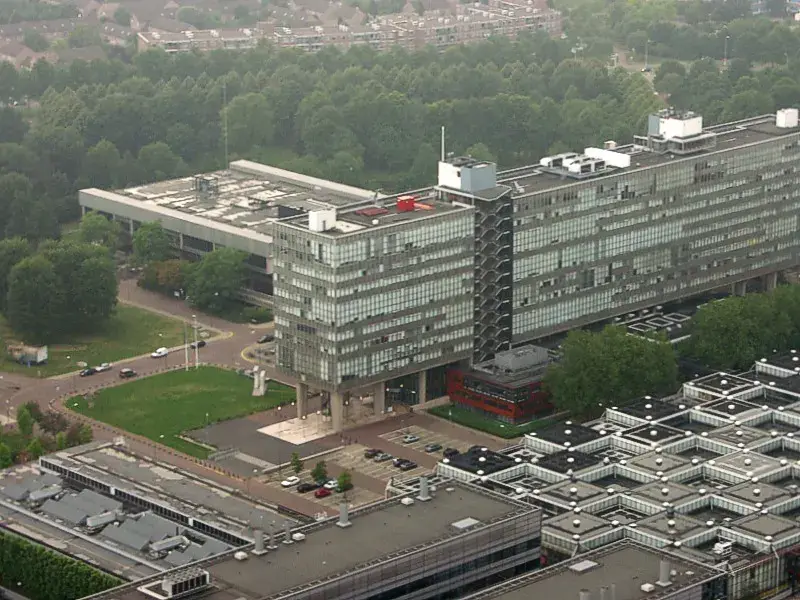
Photo: Arno van den Tillaart from Eindhoven, Netherlands · CC BY 2.0
- QS World Ranking 2027
- #152
- Founded
- 1956
- Students
- 13,000
- Bachelor's degree
- 3 years
- Acceptance rate
- Not published; four bachelor's programmes rank applicants for a fixed number of places, the rest admit applicants who meet the diploma and subject requirements
- Typical IB offer
- IB Diploma with Maths Analysis & Approaches HL; Physics HL (and Chemistry) added for physics-based programmes
- Typical A-level offer
- 3 GCSEs + 3 A-levels at A2 incl. Mathematics, each of the six subjects A*–C; Physics/Chemistry for some programmes
- How admission works
- Programmes set their own subject conditions; English is proved by IELTS Academic 6.5 (6.0 per section) or TOEFL iBT 4.5 overall and per section (scale from 21 January 2026). IB students are exempt if the IB was taught fully in English or they have English A HL with at least 5. Apply through Studielink and the TU/e Osiris portal.
- Language of instruction
- English for most bachelor's programmes; Biomedical Engineering and Medical Sciences and Technology are taught in Dutch (proof of Dutch needed, with an exemption for IB Dutch B HL or Dutch A), and Chemical Engineering and Chemistry runs in both Dutch and English tracks.
The university publishes no IB point total and no A-level grade bar beyond A*–C; selection programmes rank applicants against each other.
Worth knowing
TU/e opened in 1956 in Eindhoven, the home region of ASML and Philips, and describes itself as a top-200 research university in engineering, science and technology. Its brochure reports 43% international students from more than 100 nationalities and the largest student sports centre in the Netherlands.
How hard is it to get in, and why
Computer Science and Engineering, Mechanical Engineering, Architecture, Urbanism and Building Sciences and the English track of Chemical Engineering and Chemistry rank applicants for a fixed number of places. The ranking combines grades with online tests; in Mechanical Engineering it uses tests only. Other programmes admit anyone with the required diploma subjects, but only students with at least 45 ECTS after the first year may continue.
What it costs
Tuition
$25k per year
Non-EU/EEA institutional fee for new bachelor's students starting in 2027-28: €22 400 a year, the same for all programmes. The university raised it from the €19 200 set earlier for 2027-28; students who started a bachelor's in 2025-26 or 2026-27 keep a lower fee (€19 200 in 2027-28) until 31 August 2030. A €100 application fee applies to each programme. Living costs: the university publishes only a minimum budget of at least €10 000–12 000 a year for rent, insurance, living expenses, books and local transport and no upper figure, so the range here is the Dutch immigration service (IND) requirement of 12 months at its 2026 study norm of €1 130,77, about €13 600 (a calculation).
Living costs
$15k per year
Scholarships and financial aid
TU/e does not offer scholarships for bachelor's students. Its Scholarship for Excellence and the other listed scholarships are for master's students. Dutch government student finance depends on nationality and residence status.
How to apply
Register in Studielink, then upload documents in Osiris and pay the €100 application fee. Selection programmes close on 15 January 2027, with online tests in March 2027 and rankings sent on 15 April; the other programmes close on 1 May. The university has also stopped international recruitment for bachelor's programmes and refers non-EU applicants for the English Chemical Engineering and Chemistry track to the University of Twente.
Official websiteWhat makes it special
- 15 bachelor's programmes, each three years (180 ECTS) with a core programme and free electives.
- QS ranks it 91st in Engineering and Technology, according to the university's brochure.
- Binding study advice: students with fewer than 45 ECTS after year one cannot continue or re-enrol in the track for three years.
- 1 468 on-campus student housing units, with a lottery of furnished rooms for first-year international students.
- A capacity limit now exists on Mechanical Engineering (500 places), Computer Science and Engineering (375) and Architecture, Urbanism and Building Sciences (325).
About studying in Netherlands
Three-year bachelor's degrees, many of them taught entirely in English, with applications through the national Studielink portal. Popular programmes use numerus fixus selection with a 15 January deadline; the rest close on 1 May. Fees for non-EU students range from roughly €10,000 to €20,000 a year. Every university applies a binding study advice: earn most of the first-year credits or leave the programme.
Teaching staff
The dossier on teaching staff for this university is still being written.
The campus in photographs
Photographs come from Wikimedia Commons under free licences; the author and licence are shown on each image.
Reviews
No reviews yet. Visited, applied, or studied here? Be the first.