
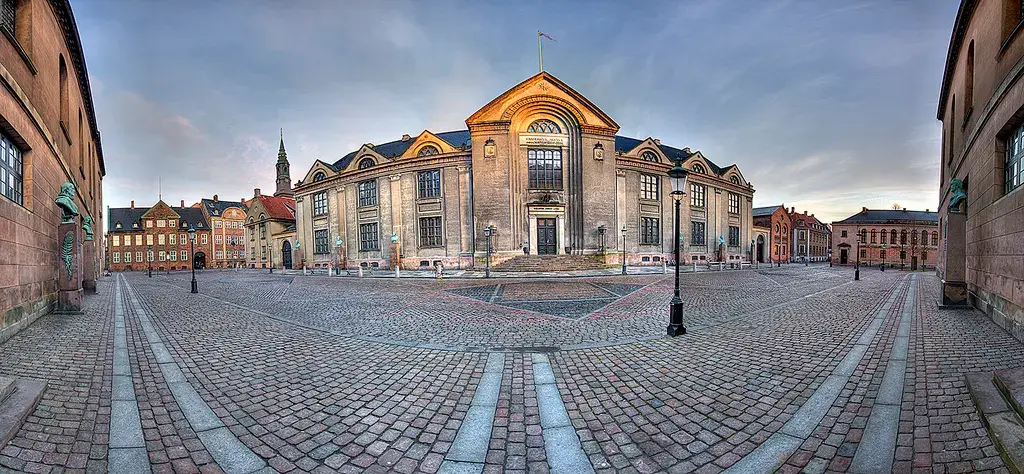
Denmark · Copenhagen, Capital Region
University of Copenhagen
A large Nordic research university where every bachelor's degree is taught in Danish
Photo: Mik Hartwell · CC BY-SA 2.0
- QS World Ranking 2027
- #90
- Founded
- 1479
- Students
- 40,000
- Bachelor's degree
- 3 years
- Acceptance rate
- Not published; places are allocated by Danish quota 1 (grade average) and quota 2 (Danish test and interview)
- Typical IB offer
- IB Diploma with a converted GPA of at least 6.0 (Danish scale) plus programme subject levels; Danish required
- How admission works
- Applications go through optagelse.dk. Every programme sets its own subject levels in Danish A/B/C terms, and IB courses are converted by the Danish Agency for Higher Education and Science rules. Applicants whose A or B HL language is not Danish, Norwegian or Swedish must pass the Danish test 'Studieprøven i dansk'.
- Language of instruction
- Danish; all 78 bachelor's programmes are taught in Danish. Applicants need Danish A or the 'Studieprøven i dansk' test (grade 02 in each of three disciplines, grade 7 for Medicine and Dentistry).
The 6.0 minimum is the general GPA requirement for quota 1; the university publishes no IB points bar and no A-level requirement. IB Course Results (not the full Diploma) qualify only with 18 points, grade 3 in all six courses and supplementary Danish A- and B-level courses.
Worth knowing
The University of Copenhagen describes itself as one of the largest research and educational institutions in the Nordic region, with about 40,000 students. It runs 78 bachelor's programmes and not one of them is taught in English.
How hard is it to get in, and why
All 78 bachelor's programmes are taught in Danish, so an international applicant must document Danish at a high level on top of the IB. Quota 1 ranks applicants by grade average, converted from the IB to the Danish scale, and each programme gets its own cut-off every year. Quota 2 consists of a test in Danish and, for some programmes, an interview in Danish.
What it costs
Tuition
$15k–19k per year
UCPH's fee tool lists DKK 100,000 or DKK 130,000 a year for each of its 78 bachelor's programmes for citizens outside the EU, EEA and Switzerland; the page does not name an intake year. The higher rate applies to programmes such as Computer Science, Physics and Biology, the lower to programmes such as Economics and Psychology. Living: the figure is not a cost estimate but the floor set by the Danish immigration agency (SIRI): DKK 7,426 a month, DKK 89,112 for 12 months, at the 2026 level. UCPH's own estimate is EUR 1,280-1,800 a month for Copenhagen, quoted in euros and not converted here.
Living costs
$13k per year
Scholarships and financial aid
The university states that it does not offer financial support or scholarships to foreign students. Citizens of countries outside the EU/EEA and the Nordic countries pay tuition unless a residence permit exempts them.
How to apply
Apply on optagelse.dk, which opens on 1 February; the deadline for all applicants with a non-Danish diploma, IB included, is 15 March at 12:00, and the requirements must be documented by 5 July at 12:00. IB graduates must ask their IB coordinator before 1 May to let the university see the results online (institution code 002600). Quota 2 applicants must register separately for the quota 2 test, which is in Danish. Answers come on 28 July.
Official websiteWhat makes it special
- About 40,000 students and 9,000 employees, according to the university.
- 78 bachelor's programmes, all taught in Danish; three years of full-time study.
- Most students continue to a two-year master's; the Medicine master's takes three years.
- Medicine students enrol twice a year, in September and February; all other bachelor's programmes start in September.
About studying in Denmark
Bachelor's degrees take three years, and applications go through the national portal Optagelse.dk; at the IT University of Copenhagen (ITU) the non-EU deadline is 15 March at noon. The University of Copenhagen teaches all 78 of its bachelor's programmes in Danish and offers English only at master's level, so check the teaching language of each programme at other institutions; ITU, for example, asks non-EU applicants for English test scores. Non-EU students pay tuition set by each institution; as one example, ITU charges EUR 8,250 a year for 2026 admission (EUR 49,500 for the three years) plus a EUR 150 application fee. At the University of Copenhagen a bachelor's is taught in Danish.
Teaching staff
The dossier on teaching staff for this university is still being written.
The campus in photographs
Photographs come from Wikimedia Commons under free licences; the author and licence are shown on each image.
Reviews
No reviews yet. Visited, applied, or studied here? Be the first.