
Spain · Madrid, Community of Madrid
Complutense University of Madrid (Universidad Complutense de Madrid)
Spain's big Madrid public university, the most requested in the Madrid region, strong in humanities, law, health and sciences
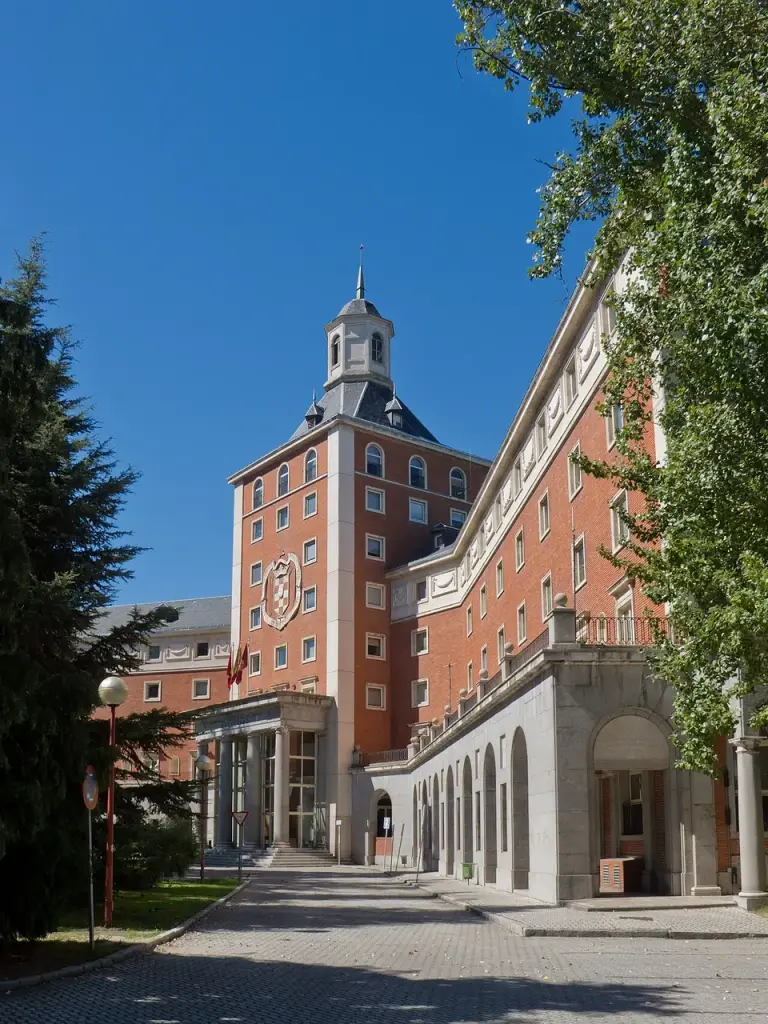
Photo: Carlos Delgado · CC BY-SA 3.0
- QS World Ranking 2027
- #199
- Founded
- 1293
- Students
- 64,000
- Bachelor's degree
- 4 years
- Acceptance rate
- Not published for international applicants; 69.9% of the 23,349 applicants who put UCM first got a UCM place (2025-26, July 2025 allocation, all applicants who chose UCM first)
- Typical IB offer
- IB Diploma + UNEDasiss accreditation; Spanish B2 if applicable; no points bar published
- Typical A-level offer
- UK A-levels via UNEDasiss accreditation (UK is on UCM's agreement list); no grade bar published
- How admission works
- Applicants from non-Spanish-speaking countries whose school system is not in Spanish must show Spanish B2, checked through UNEDasiss; ADE in English and Economics in English ask for English B2. The admission mark counts the two best weighted subject marks from UNEDasiss specific competency tests (PCE), recognised subjects or the PAU voluntary phase. Cut-offs for 2025-26 (Group 1, which UCM says includes IB) ran from 5,000 to 13,698; Business Administration was 9,564 and Medicine 13,100.
- Language of instruction
- Mostly Spanish. ADE and Economics are also offered in English (English B2 required), and some international double degrees run in English, French or German. Applicants from non-Spanish-speaking countries and school systems must show Spanish B2.
A cut-off mark is the admission mark of the last student placed in a given year, not a published requirement. It changes every year with demand.
Worth knowing
UCM reports 64,407 official students in 2025-26 (61,165 in its own centres), the most-requested university in the Madrid single district. In July 2025, 18 students were admitted across the district with the maximum admission mark of 14, six of them to UCM, three of whom chose Medicine.
How hard is it to get in, and why
Entry is formal and ranked by admission mark (out of 14): in 2025-26 the Complutense cut-offs ran from the minimum 5,000 in degrees with free places to 13,698 for the Mathematics–Physics double degree and 13,100 for Medicine. Non-Spanish-speaking applicants must show Spanish B2. Rated by analogy with Amsterdam and TUM: formal admission, with a grade ranking that decides only the oversubscribed degrees.
What it costs
Tuition
$8k–9k per year
UCM charges non-EU students without residence in Spain the fourth-enrolment price from the first year (Decree 43/2022 of the Community of Madrid), without prejudice to international agreements and treaties: nationals of a country with an applicable agreement pay the first-enrolment price (EUR 16.92–20.68 per credit), and UCM does not say whether Thailand is one of them; a study-stay authorisation does not count as residence. For 2026-27 that is EUR 113.71 per credit for level 3 degrees (e.g. Law, Economics, Psychology, ADE), EUR 128.57 for level 2 and EUR 136.44 for level 1 (e.g. Medicine, Biology). The Community of Madrid says a full year usually has 60 credits (UCM's full-time minimum is 48), so EUR 6,823 to EUR 8,186 is a calculation (60 × price), plus EUR 6.11 and, for new students, EUR 27.54 in file fees; 2027-28 prices are not published yet. Living: UCM's own estimate is EUR 900–1,300 a month, times 12 as a calculation; the Spanish student-visa floor is EUR 600 a month in 2026.
Living costs
$12k–18k per year
Scholarships and financial aid
UCM lists tuition aid for non-EU students not resident in Spain or the EU: 35% of the public price of the enrolled bachelor's credits. The page shows the 2022-23 call as the latest, with applications in March, so check for a current call.
How to apply
IB holders first request UNEDasiss verification and an admission mark, then apply through the Madrid single-district portal (one application, up to 12 degrees). For 2026 entry the UNEDasiss pre-enrolment period ran from 5 June to 6 July (until 14:00); the 2027 dates are not published yet. UCM also runs an early-admission procedure for applicants whose family lives outside Spain: for 2026-27 applications ran from 22 January to 1 April 2026 for up to three degrees, with a limited number of places per degree in the call (for example 20 in ADE and 15 in Law); predicted grades can be attached. Selection looks at the final grade, grades in subjects related to the degree and the fit of the curriculum.
Official websiteWhat makes it special
- 74 bachelor's degrees and 22 double degrees in 2025-26, plus 16 international degrees.
- Medicine is the most requested degree in Madrid: 3,958 first-choice applications and a 13,100 cut-off in 2025-26.
- Joint degrees with partners: Bachelor of European Studies, a double Economics degree with Paris 1 Panthéon-Sorbonne and a double ADE with HWR Berlin.
- Early-admission procedure for applicants living outside Spain, including IB students (22 January to 1 April in the 2026-27 cycle).
- Students of the Madrid public universities apply through one single-district portal, up to 12 degrees in a single application.
About studying in Spain
A grado such as the University of Barcelona's International Business takes four years (240 ECTS). Programmes are generally taught in Spanish (the Complutense of Madrid asks applicants from non-Spanish-language school systems for B2 Spanish), with exceptions such as that UB programme, which is about 74% in English. IB holders first obtain a UNED accreditation (UNEDasiss), valid for two years, and then pre-enrol at universities in an extended pre-enrolment period; the admission grade counts only the two best subjects that weigh most for the chosen degree. Public prices are set by the region: UB and UAB list EUR 17.69 per credit, so roughly EUR 1,060 for a 60-credit year, and I could not confirm whether non-EU students pay a different rate. The honest caveat is the Spanish language and the extra accreditation step.
Teaching staff
The dossier on teaching staff for this university is still being written.
The campus in photographs
Photographs come from Wikimedia Commons under free licences; the author and licence are shown on each image.
Reviews
No reviews yet. Visited, applied, or studied here? Be the first.